If you are looking for a MEDICAL BATTERY CHARGER, use our ordering page.

The hydrogen economy is not going to save us from rising energy costs!
You need your own
Personal Energy Plan.
Save 1/100th of a tree
 Buy the eBook
Also available at
Chapters Indigo,
Amazon,
iUniverse and more
The Econogics Blog 
April 30, 2020
[March 2024 commentary:As I have been returning to these blogs almost 4 years after they were written, mostly to identify the dead links, I perceive a pattern I had not really expected. The items which reflected the mood of the time related to COVID-19 have a significantly higher rate of erasure from the websites than those unrelated to COVID-19 or those that, in retrospect, played down the real impacts of the pandemic. I see this as odd as we are still dealing with the consequences, but seem determined not to address them in a meaningful way. That's not just 'long-COVID' health consequences which are real enough, or the continued impacts on health care 'systems' that were traumatized and reduced in effectiveness, but even in financial consequences like the CERB and CEBA repayment pressures from CRA as businesses and workers are still reeling from the teetering economy. It's also stories of how governments bullied suppliers with the COVID-19 spectre, and are now reneging on commitments to cover additional costs of continuing work during the worst days of the pandemic. Like: Construction firms that built critical Ontario infrastructure projects during COVID say the province stiffed them
https://globalnews.ca/news/10324443/ottawas-shark-tank-fast-track-program-helped-rapid-test-contractors-land-billions/
Another thing that was annoying was the rise in cyber-crime from cyber-vandalism, to massive phishing campaigns to enable ransomware attacks, and online identity theft, all feasting on more people using their Interweeb connections more for entertainment, social contact and work. As a result, I started creating links which showed the exact URL of the link in the hyperlink text so people could know they weren't clicking on a misrepresentation of the link in my posts. An extra line for every link, and an annoying opportunity for more typos. Even though we have purportedly come out the end of the pandemic with casualties, people aren't dropping their dependence on the 'net, and the bad guys, having tasted easy money from victimization of others have simply sharpened their tools and ramped up their activity leveraging the money they are getting from those that choose to pay the ransoms rather than having put effort into prevention and protecting themselves. (As someone who worked in keeping systems secure as ransomware was nascent, and being turfed from the gig where that was part of what I did, I find that still wrankles.)
COVID-19
Warning: these posts are for 'adults'; people with the ability to think for themselves, take responsibility for their actions, and prepared to work for the greater good. If that isn't you, remember to wash your hands and face with soap regularly and don't touch anything. Stay home. The Internet has plenty of content to entertain you.
Hey Canada, thanks to COVID-19, today isn't income tax filing deadline day for individuals. Feel better?
MB, PE and NB are moving ahead with lifting restrictions withiin days. Their reported cases show the best situations across Canada, but the officials do recognize the risk and are generally looking to lift restrictions slowly. NL, YT, NT also show zero or very low new cases numbers. AB and SK continue to show accelerating new cases per day. BC, ON, QC and NS keep rising at relatively steady rates. I am concerned for Quebec's plans for lifting restrictions more dramatically despite adding 837 new cases yesterday alone.
Yesterday I showed Canada's performance against some of the world's best. Today, against
some of the worst.
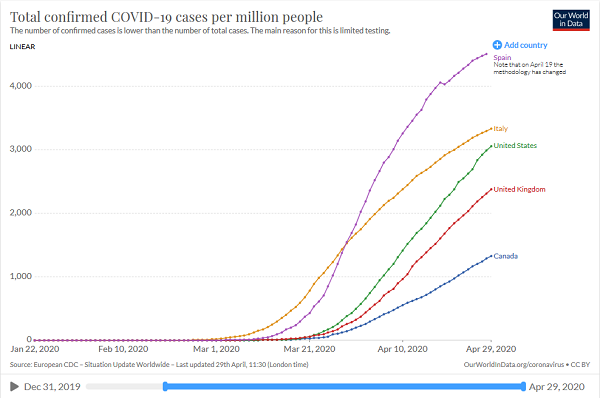
The chart was generated on April 29, 2020. Source:
https://ourworldindata.org/grapher/total-confirmed-cases-of-covid-19-per-million-people?tab=chart&year=2020-04-28&country=CAN+USA+GBR+ITA+ESP
It really isn't cause for complacency. Continue with a healthy skepticism on 'facts' and 'data' being presented.
Opinion: Lies, Damned Lies and the Actual Coronavirus Statistics
https://timesofsandiego.com/opinion/2020/04/29/lies-damned-lies-and-the-actual-coronavirus-statistics/
The Temptation of Unproven Treatments
I'm spending a fair bit of time these days looking at various actions which can possibly improve the pandemic situation on a range of fronts. The one that generates the highest volume of comments to me is the range of 'cures' which someone is sure will solve the COVID-19 health emergency. I understand the desire to do something, but rule 1 is do no harm. We have to prove an approach or medication works before providing it to millions of people. Here's an article that helps explain the situation.Coronavirus: How medical experts are deciding which treatments should be used for COVID-19
https://theconversation.com/coronavirus-how-medical-experts-are-deciding-which-treatments-should-be-used-for-covid-19-136500
Silver Linings
Study of 10 Major Cities: Air pollution levels are dropping at unprecedented rates
https://www.iqair.com/ca/newsroom/report-impact-of-covid-19-on-global-air-quality-earth-day
(includes constructive suggestions on how to keep the air quality improvements 'after')
Solar abundance enables the UK’s longest period without coal-fired electricity
https://eandt.theiet.org/content/articles/2020/04/solar-abundance-enables-the-uk-s-longest-period-without-coal-fired-electricity/
'After'
I'm going to dip a toe into the subject of 'after', but just a taste. It's going to be an adjustment in mind set to shift from 'now' with its seemingly endless streams of chaos and bad news. It is said that crisis presents opportunity. How about taking this disrupted time, where some of us are scrambling and some forced into idleness to think about how we could make 'after' not only better than 'now', but better than 'before'. Take your time with this; the word count is small, but the content is huge.
My vision of 'after' includes these six core items.
1) Safe air to breathe
2) Safe water to drink
3) Safe food to eat
4) Safe soil to nurture food and other plants
5) Safe shelter from the elements and other dangers
6) Wild waters that can sustain marine life and land that can support flora and fauna
Make all of those sustainable for your grandkids - and their grandkids (seven generations including you).
Figure which of those you're opposed to, because the rest builds on those.
I'm aware that having those things are truly unacceptable to those at the levers of power in the neo-liberal 'free-market' economic system we lived in until January. I'm not quite sure what to call what we have 'now', but I think it's different than 'before'. Perhaps we can just call them 'interesting times' for the present.
Can we keep a few COVID-19 things for 'after'? Like:
a) the remarkable adult behaviour in the federal House of Commons Question Period
b) less traffic on our roads
c) less physical commuting to work
d) better air quality
;-) Not to brag, but I've always washed my hands and used toilet paper,
even before it was hip and trendy.
Spread knowledge, not the virus.
Stay well, stay safe, stay sane, STAY HOME. Take some time to think.
We're not done yet. Not nearly.
April 29, 2020
COVID-19
Warning: these posts are for 'adults'; people with the ability to think for themselves, take responsibility for their actions, and prepared to work for the greater good. If that isn't you, remember to wash your hands and face with soap regularly and don't touch anything. Stay home. The Internet has plenty of content to entertain you.
People with access to mainstream media keep saying Canada is doing OK on COVID-19, so we're ready to 're-open', because they compare Canada to the worst in the world.
Take a look at the chart below, and compare Canada's new case count to 3 countries which have taken COVID-19
seriously, early. That data is in per-capita format, so it's not about skewing due to population size.

The chart was generated on April 28, 2020. Source:
https://ourworldindata.org/grapher/total-confirmed-cases-of-covid-19-per-million-people?tab=chart&year=2020-04-28&country=CAN+JPN+NZL+TWN
I take no comfort in having the new cases numbers rumble along between 1500 and 1600 a day while I know we are not doing enough testing to be able to rely on that data. COVID-19 is not finished with us yet. Let's remember who's in charge here - it's not us - it's the virus. At this stage, I would summarize as we could have done better, and we certainly could have done worse.
Vaccines
Why a COVID-19 vaccine could take much longer than 12 to 18 months
https://www.ctvnews.ca/lifestyle/article/why-a-covid-19-vaccine-could-take-much-longer-than-12-to-18-months/
Saskatoon-based research lab's COVID-19 vaccine moves into animal trials
https://www.ctvnews.ca/saskatoon/article/saskatoon-based-research-labs-covid-19-vaccine-moves-into-animal-trials/
Ottawa scientists turn attention to COVID-19 vaccine with help from 'fast grant'
https://ottawacitizen.com/news/local-news/ottawa-scientists-turn-attention-to-covid-19-vaccine-with-help-from-fast-grant/
'Before', 'Now', and 'After'
We're not ready for 'now'. We're continuing to learn the extent to which we weren't
even fully functional 'before'.
You're not ready to think about 'after', yet. I'm a project manager by inclination and sometimes
profession, and I'm telling you you're not ready.
The 'magic' doesn't just happen. It's the result of a lot of really hard work, well executed.
If you didn't notice all that work and execution, that's why you think it's 'magic', or it was easy.
It's not and it wasn't.
One of my project mottos: Failure is not an option; it comes standard.
If your project is a success, it's because the project team made it happen.
If you find you have great team, hang onto them. It's amazing what can happen when success
becomes a habit.
Project success should never be an expectation. If you expect to succeed because this has
been done before, it's not a project, it's a process.
Let's try an analogy for societal response to COVID-19.
Like our body and immune system, everyone felt fine and we appeared healthy. Then the SARS-CoV-2 virus hit. All sorts of symptoms appear, which varied in type and severity by individual, as severity and response varied by jurisdiction. As the virus moved from person to person, the pandemic moved from country to country and region to region. If the symptoms in a human were severe enough, it affected multiple internal organs and symptoms, and slowed us down or took us out of action. At a societal level, the spread of the virus impacted schools, workplaces, social activities - the equivalent of lethargy and having to take time off. The health care 'system' (focused on hospitals and primary care doctors) and the shadow health care patchwork acts as our societal immune system.
Just as being healthy with a robust immune system helps when one encounters SARS-CoV-2, so a strong set of health care resources helps when society is hit by COVID-19. In much of Canada, our health resources were not in good shape, as reflected by the need to 'flatten the curve' so the hospitals would not be overwhelmed; the lack of appropriate PPE available; health care and shadow health care workers getting sick; under-resourced in the shadow health sectors; and an economic diet too dependent on high energy snacks (oil and gas) and not getting enough essential nutrients (diversified economy) and complex carbohydrates (value-add processing) to keep us going over the long-run. In the 'after', we need to do better on a balanced economic diet, and building up a healthy immune system.
Getting to 'After'
1) survive 'now'
2) have a vision (what are the desired outcomes, how do things work in
the 'after', and why?)
3) have a strategy
4) get buy-in (real 'skin-in-the-game' commitment)
5) assemble the team
6) start building the plan - identify prerequisites for the various
objectives, weigh options, develop contingencies, determine required
resources
7) overfund and overstaff - you need momentum to overcome early
roadblocks
8) do the work, learn, adjust, keep moving forward
9) completion - at each major milestone, evaluate what went well, and
what could have gone better
10) celebrate achievements - even little ones, especially early on -
recognize your heroes (it's almost always a small group, not an
individual)
We'll start unpacking that another day.
;-) Dog to human: "Stay" I understand.
When did you change my name to "Home"?
Spread knowledge, not the virus.
Stay well, stay safe, stay sane, STAY HOME.
We're not done yet. Not nearly.
April 28, 2020
COVID-19
Warning: these posts are for 'adults'; people with the ability to think for themselves, take responsibility for their actions, and prepared to work for the greater good. If that isn't you, remember to wash your hands and face with soap regularly and don't touch anything. Stay home. The Internet has plenty of content to entertain you.
Canada is not flattening the curve on new cases at this point. None of BC, AB, ON or QC should be lowering their guard at all. SK is showing a troubling new spike in new cases in the past week. Similar in MB, but slightly more gradual than SK. NS new cases rate is still relatively high. We saw the usual pattern of lower numbers on the weekend, and then rising on Monday. The reported death count rose by 5% in one day yesterday. While death count is a lagging indicator, this isn't in any way a positive result, but the magnitude of this number could be a Monday effect.
I understand people are really looking for some good news, and elected officials are grasping at straws to come up with something, even if it's fudging on what 'flattening' the curve means, or excluding pocket outbreaks as though those cases and deaths somehow aren't people the way that others 'in the community' are.
I prefer it when I have a way to do a 'reality check' on the stories and data being pushed at me
for consumption. Here's one to contemplate. Death counts are more reliable than 'confirmed new cases'
because we simply don't do enough testing to have faith in the new cases numbers. We're pretty good
now at understanding what a death is.
Global coronavirus death toll could be 60% higher than reported
https://www.ft.com/content/6bd88b7d-3386-4543-b2e9-0d5c6fac846c
If that didn't depress you, consider that the deaths typically follow contracting the virus by
weeks, and possibly months, not even allowing for delays and inaccuracies in reporting. And this:
There's no wide-scale post-mortem COVID-19 testing in Ontario. Why experts say this is a 'national embarrassment'
https://www.thestar.com/news/gta/2020/04/27/the-urgent-case-for-testing-the-dead.html
Trendline forecasting is risky. Doing it by extrapolating based on very limited data (e.g. a few good days from a limited portion of the population) is unwise.
We think the incubation period is around 2 weeks. If you are going to take any decision based on
new case counts, I think you need to take at least three precautionary measures.
1) Nothing opens until you have at least two uninterrupted weeks of good news data (to allow for
the 'yahoo' factor). The longer the 'yahoos' (term courtesy Ontario Premier Doug Ford) keep violating
the self-isolation and physical distancing rules, the longer we all get to stay locked down. The other
option is to lock up those who won't lock down.
2) The positive data has to include EVERYONE in the jurisdiction. High risk 'pockets' require 100%
testing, which means the results have to be in, not just the swab taken. If testing takes 6 days to
provide results, extend the 2-week window by that lag factor to determine the uninterrupted good news
period.
3) Offer/require testing of EVERYONE going back to work and require them to remain in strict
self-isolation until they get a negative result from their test.
Remember, it's all a gamble until we are testing EVERYONE. We don't know as mucn about this virus as we need to know. If you think being exposed to the SARS-CoV-2 virus confers long-term immunity, think about the fact that we offer ANNUAL flu shots; for another set of coronaviruses.
We don't have a handle on antibody tests yet
Antibody surveys suggesting vast undercount of coronavirus infections may be unreliablehttps://www.sciencemag.org/news/2020/04/antibody-surveys-suggesting-vast-undercount-coronavirus-infections-may-be-unreliable
Antibody testing for COVID-19 isn't the quick fix it's been made out to be
https://www.theglobeandmail.com/canada/article-antibody-testing-for-covid-19-isnt-the-quick-fix-its-been-made-out/
[Don't trust this headline, read the article]COVID-19 Antibody Testing Brings Cautious Hope
https://www.webmd.com/lung/news/20200427/covid-19-antibody-testing-brings-cautious-hope
Infectious Disease Expert: FDA Has 'All But Given Up' Oversight On Antibody Testing
https://www.huffingtonpost.ca/entry/fda-coronavirus-testing-expert_n_5ea5a641c5b6f9639816bc46
FDA pushed through scores of inaccurate antibody tests without agency review
https://www.politico.com/news/2020/04/27/reliable-antibody-tests-coronavirus-207589
Canada launches serological testing initiative to help manage COVID-19
https://www.mcgill.ca/newsroom/channels/news/canada-launches-serological-testing-initiative-help-manage-covid-19-321802
From the broken record current chart toppers
We're not doing enough testing to be able to fully trust the data on new cases.
We don't have a reliable source of safe PPE sufficient to our needs.
We don't have a valid antibody test. Period.
Do not self-administer anti-malarial drugs except under medical supervision for malaria.
(I can't really believe I have to say this, but poison control centres really did get calls.)
Do not drink chlorine bleach. Do not inject or ingest disinfectant. Do not expose yourself to intense UV light.
We're not ready to 're-open'. There is evidence we're not smart enough (see item above).
The golden oldies
Wash your hands frequently with soap including all seven steps.
Self-isolate other than to go to work, get food and necessities. In other words, stay home.
Maintain a safe distance from others when outside the home (at least 2 metres), aka physical distancing.
Wear a mask if you are likely contagious and have to be out, to protect others. Preferably a fitted, medical mask.
If you have symptoms, take a self-assessment or call a medical professional to get further instructions - and FOLLOW THOSE INSTRUCTIONS.
Cough or sneeze into a tissue or your elbow.
Be kind to others.
;-) So, apparently we have eight more months of 2020?
That can’t be right.
Spread knowledge, not the virus.
Stay well, stay safe, stay sane, STAY HOME.
We're not done yet. Not nearly.
April 27, 2020
COVID-19
Warning: these posts are for 'adults'; people with the ability to think for themselves, take responsibility for their actions, and prepared to work for the greater good. If that isn't you, remember to wash your hands and face with soap regularly and don't touch anything. Stay home. The Internet has plenty of [dead linik: https://www.youtube.com/watch?v=dQvWTrW8Zww] content to entertain you.
Alberta's recent spikes in new cases means it has now overtaken Ontario for second place for the most cases per capita in Canada, and it's trendline is the steepest in the country.
As elected leaders are clearly anxious to make 'good news' announcements about 're-opening',
I hope they keep in mind both the six criteria provided by the World Health Organization, and
the risk of creating a second wave of new cases. Testing and more testing is still the key
to a safe ramp-up of activities. We're definitely not there yet for most of Canada.
https://www.cbc.ca/news/health/covid19-testing-explainer-1.5540418
Disinformation
https://www.cbc.ca/news/canada/covid-19-misinformation-rumour-1.5532302
https://theconversation.com/conspiracy-theorists-are-falsely-claiming-that-the-coronavirus-pandemic-is-an-elaborate-hoax-135985
A new Canadian site calling out COVID-related disinformation
https://covid19misinfo.org/
Facebook remains a disinformation engine, intentionally and for profit.
Want to Find a Misinformed Public? Facebook's Already Done It
[dead link: https://themarkup.org/coronavirus/2020/04/23/want-to-find-a-misinformed-public-facebooks-already-done-it]
https://themarkup.org/coronavirus/2020/04/23/want-to-find-a-misinformed-public-facebooks-already-done-it
Sunlight might kill the coronavirus on surfaces, but experts reject Trump's 'exceedingly
dangerous' ideas about using it on the body
https://www.businessinsider.com/sunlight-might-kill-coronavirus-uv-rays-not-treatment-2020-4
And there is the new wave of phishing attacks, like the 'your e-mail account will be deactivated,
click here to cancel'. I got one this morning that actually claimed copyright for my business as
part of the e-mail con.
Remember, good computer hygiene as well as good COVID-19 hygiene.
Taiwan
Based on data I can find, Taiwan is another jurisdiction which seems to have a handle on COVID-19 management. But it's not getting much coverage.[dead link: https://www.pri.org/stories/2020-04-07/taiwan-s-success-fighting-covid-19-overshadowed-global-politics ]
However, officials who want to understand how to effectively tackle the COVID-19 threat in an open democracy might want to take note of what Taiwan's approach has been.
https://jamanetwork.com/journals/jama/fullarticle/2762689
https://atlanticcouncil.org/blogs/new-atlanticist/lessons-from-taiwans-experience-with-covid-19/
https://foreignpolicy.com/2020/04/13/taiwan-coronavirus-pandemic-mask-soft-power-diplomacy/
Taiwan is not assuming that they have beaten the virus yet. Another lesson for others.
[dead link: https://www.voanews.com/science-health/coronavirus-outbreak/covid-19-cases-near-zero-taiwan-restrictions-remain ]
Mixed Messaging
Taking a cue from the federal government, a couple of provinces - notably Ontario - have indicated they will provide a $4 per hour pay boost to certain front-line workers in the shadow health sectors (e.g. long-term care, nursing homes, home and community care). COVID-19 has shone an uncomfortable light on some dark truths for workers in those areas which have been endemic for decades. I'm all for this recognition, and I think these workers deserve this sort of pay rate and more full-time employment than was common practice 2 weeks ago.
My concern is that the provincial announcement includes a 16-week limit on these financial measures. We don't know when COVID-19 will cease being a threat to health service workers, so why set an end-date now? Four months is not long enough to attract workers into a field with long-term shortages of workers. As a message, the short timelime makes the gesture ring hollow; a band-aid for a problem that needs rehab.
Energy Use
In the past few days, Ontario has been exporting anywhere from 2.5 to 4 GW of electricity. At one
extreme point (April 22 at 3 a.m. to 4 a.m. - a Wednesday), 24% of electricity generated in Ontario was
being exported. Presumably this was displacing more expensive coal and natural gas generation in the
U.S. northeast, which is already experiencing demand reductions itself.
https://www.eenews.net/stories/1062798303
The Ontario Independent Electricity System Operator (IESO) provides pretty good data.
http://www.ieso.ca/Power-Data
It's harder to pin down the oil and natural gas sectors, but seeing the price of WTI hit -US$37 a barrel for a few minutes last week probably gives a pretty good sense of the demand destruction for refined oil products.
What is most telling to me is that somebody was actually 'selling' oil (May WTI futures) at that price on the spot market. How dire is your situation if you are paying somebody $37/bbl to take your product?
I got our first COVID-era electricity bill. I expect some people are using more electricity at home as a result of work-from-home and self-isolation measures. Originally, I expected our bill to drop with one electric car essentially parked and the other travelling much less. On the flip side, we have more than a typical amount of compute power in our house, and it's been largely dedicated to Folding@Home as other work has dried up since mid-March. If our contribution to finding a treatment for SARS-CoV-2 makes a difference, we're happy to do it. It's been odd to have the basement be the warmest place in the house.
;-) https://www.youtube.com/watch?v=wdcS0Nbo7Ng&feature=youtu.be
(3-and-a-half minutes)
Spread knowledge, not the virus.
Stay well, stay safe, stay sane, STAY HOME.
We're not done yet. Not nearly.
April 26, 2020
COVID-19
Warning: these posts are for 'adults'; people with the ability to think for themselves, take responsibility for their actions, and prepared to work for the greater good. If that isn't you, remember to wash your hands and face with soap regularly and don't touch anything. Stay home. The Internet has plenty of content to entertain you.
Case counts as of Friday are accelerating again in Ontario, Quebec, BC and Alberta. Media reports suggest most of these are related to pockets, mostly workplaces where isolation measures were not well implemented. We need to take COVID seriously everywhere, or it is just going to keep coming back to bite us. Data from the 25th appears incomplete, so I'm not working from it.
New Computer Issues - risks of working at home
Forbes: Google Just Gave Millions Of Users A Reason To Quit Chrome, Windows 10.
https://www.forbes.com/sites/gordonkelly/2020/04/23/google-chrome-critical-security-exploit-windows-10-upgrade-warning-update-chrome-browser/
Forbes: Apple Confirms New Warning Affecting Almost All iPhone Users
https://www.forbes.com/sites/gordonkelly/2020/04/23/apple-iphone-exploit-vulnerability-ios-13-mail-problem-iphone-11-pro-max-u-iphone-xs-max-xr-update/
TechSpot: Another text string that can crash Apple devices is making the rounds.
https://www.techspot.com/news/84977-another-text-string-can-crash-apple-devices-making.html
Security advice for Zoom users: How to Prevent Zoom-Bombing
https://www.pcmag.com/how-to/how-to-prevent-zoom-bombing
Food
Good news in Ontario. Community gardens are now deemed an 'essential service', so we'll be
better prepared for relocalizing food production a few months from now. Also a great reason to
get outside for an hour each day or two, and reconnect with nature and food supply in an
up-close-and-personal way. Learn more here:
https://sustainontario.com/initiatives/community-garden-network/
Caremongering
Toronto Star: Billionaires, we don't need your 'generosity.' We need the kindness seen in
a Kitchener grocery store.
[paywalled: https://www.thestar.com/opinion/star-columnists/2020/04/22/billionaires-we-dont-need-your-generosity-we-need-the-kindness-seen-in-a-kitchener-grocery-store.html]
Boy Scout 3D Prints 'Ear Guards' to Help Relieve Hospital Workers’ Pain Caused by Face Masks
[dead link: https://mymodernmet.com/3d-printed-ear-guards/]
Making a Difference in Canadian Communities
These masks are comparable to N95 and can last one month, says local manufacturer
https://edmonton.ctvnews.ca/these-masks-are-comparable-to-n95-and-can-last-one-month-says-local-manufacturer-1.4911076
GM Oshawa Plant Will Now Produce Millions of Masks Following Worker Mobilization: CUPE Ontario
https://www.businesswire.com/news/home/20200424005507/en/GM-Oshawa-Plant-Produce-Millions-Masks-Worker
New respite centre for Ottawa's homeless to 'make a big difference'
https://www.cbc.ca/news/canada/ottawa/homeless-ottawa-covid-1.5544164
I know there are many more examples, and I'm happy to share innovative ideas here. I marvel at
the range of response from individuals with 3D printers and sewing machines to retooling part of
a giant automobile assembly plant.
In my opinion, the sweet spot is small and medium size businesses which demonstrate capacity by stepping up so we can have a reliable, quality domestic supply of critical items in the future, which can create new jobs (or save old ones) during the ramp-up period. The next time, parties we're relying on may choose to close off trade completely, not just ship us defective product or hold it for internal needs during the emergency.
There's an opportunity here for local chambers of commerce, service clubs, municipal governments (Economic Development offices) and others to reach out into their communities to learn what capacity exists, and how it can be utilized. (Hint: pick one agency per community to reduce duplicated effort, but use all to communicate the strategy and direct to the information collection point.)
Plastic Grocery Bags
This one is a personal peeve. A lot of people (including me) worked hard over the years to get
a reduction in the use of flimsy grocery bags. But somehow, COVID-19 has erased all that progress.
The grocery stores won't allow me to take my reusable cloth bags into the store, for fear they might
carry and transmit the virus. I'm not clear on why that's an issue. Evidence to date says the
virus survives longer on plastic than on cloth.
https://www.theverge.com/2020/4/2/21204094/plastic-bag-ban-reusable-grocery-coronavirus-covid-19
If the only things the reusable bags touch while in the store are me and the grocery cart, there should not be any
contagion risk beyond what is already present from the products I'm going to pick up in the store.
I'm prepared to pack my own groceries, and only having my bags in the cart, before and after loading
them, so no grocery worker will ever touch them. No dice. Perhaps we could create 'hooks' outside the
store where I could hang my bags until I exit, and then packing them and putting the loaded bags back in
the cart to take them to my car. No luck with that either.
So, for now, I load my cart, go through the cash asking the cashier for no bags and then put them back in the cart. The cashiers always tell me it's OK, the plastic bags are free now. I decline them again. I'm not going to have more contents after the check-out than I had before, so it's all going to fit in the cart again. Then, I take the groceries out to the (electric) car, and load them in my bags at the car, and return the cart to a corral. It's extra effort, but no new disposable plastic bags are used. And I do respect that grocery workers don't need anything else to worry about, even if I think this one is a non-issue.
The thing about refusing plastic bags is not the nickel I was charged for them before, or the plastic
industry studies saying single-use bags are cheaper than paper or cloth bags, or that it takes multiple
uses of a re-usable bag to have a lower energy use than making the flimsy plastic bags.
https://www.reusethisbag.com/articles/reusable-vs-plastic-grocery-bags-a-look-at-the-ongoing-ban/
There are lots of studies on this topic. But they seem to agree that if I use my reusable bag 20 to 40 times,
then the energy use question of creating the bag is resolved (yes, there is one outlier study that says 171
times for a very specific type of cotton bag with no prior use of the material). I have taken issue with
those studies for a range of reasons (don't include string bags - which use much less material; don't
allow for bags made from repurposed fabric - we throw away a lot of clothing; don't include the energy
cost of moving single-use bags to the store 20 or 40 or 171 times from the point of manufacture; don't
include the energy costs of collecting the single-use bags for recycling; and certainly don't include
the environmental impact of the fugitive bags on the environment.)
It's about the damage the flimsy bag does when it escapes into the environment. Because a lot of them do.
https://www.biologicaldiversity.org/programs/population_and_sustainability/sustainability/plastic_bag_facts.html
https://www.eartheclipse.com/environment/serious-effects-plastic-bags.html
There is no municipal recycling program for them. The few bins I used to see at stores for depositing
the disposable bags for recycling have disappeared since COVID-19 began. The escaped bags break down and become microplastics
and enter the food chain that ends with us eating them.
https://www.chemistryworld.com/news/humans-consuming-thousands-of-microplastic-particles-in-their-food-every-year/3010600.article
They also add to GHG gas emissions when they break down in the ocean.
https://www.bbc.com/news/science-environment-45043989
;-) Side effect of quarantine. It's really hard to end phone calls.
Twice today I almost said "Okay, I have to run" before realizing
there is nowhere to run to.
Spread knowledge, not the virus.
Stay well, stay safe, stay sane, STAY HOME.
We're not done yet. Not nearly.
April 25, 2020
COVID-19
Warning: these posts are for 'adults'; people with the ability to think for themselves, take responsibility for their actions, and prepared to work for the greater good. If that isn't you, remember to wash your hands and face with soap regularly and don't touch anything. Stay home. The Internet has plenty of [dead site: https://www.itworldcanada.com/slideshow/10-online-distractions-you-may-or-may-not-have-discovered-during-social-distancing] content to entertain you.
The number of new cases in Canada continues to rise, and on a rolling 3 and 7 day basis,
still accelerating. Quebec is trending down slightly on new cases. Ontario is rising, as is
Alberta. We need more testing to fill in the data gaps. Like this: information good enough
for decision-making.
https://www.thestar.com/news/gta/2020/04/23/a-mobile-testing-team-swabbed-every-resident-in-a-toronto-nursing-home-for-covid-19-what-they-found-is-saving-lives.html
A spark of truth out of Ontario about reporting and testing. iPHIS data quality is a long-term known issue.
https://toronto.ctvnews.ca/ontario-admits-covid-19-death-toll-is-significantly-higher-than-what-it-reports-daily-1.4910361
But like front-line workers without enough proper and quality PPE, we work with what we have.
We're Not Ready to "Re-open"
The following commentary is based on data as available to the public as of Friday, April 24th, or in some cases somewhat earlier than that. It's COVID-19, so things will change, and we will continue to learn.
This message is for decision-makers who are now announcing their plans to "re-open the economy".
The "economy" did not close. Oil stocks took a real beating because Russia and Saudi Arabia started a price war to obliterate the U.S. fracked shale oil industry. That was not because of COVID-19. Canada's 'oil' (actually bitumen) industry is just collateral damage; we make a lower-quality, more expensive product and steadfastly refuse to invest in more value-add industry. COVID-19 demand destruction is just the icing on an already toxic cake of financial reality, sitting on a pedestal of taxpayer-funded subsidies.
The "economy" did not close. Product continues to move to market and consumers. We are still heating our houses. Many of us are working from home. Some are shifting their work from production which is sidelined to making PPE and other products in demand due to COVID-19. We are smart, adaptable and looking for opportunities to protect and improve our communities in the face of adversity and challenges. We have food and medications and other necessities. Even toilet paper.
What we don't have are the things which are contrary to the isolation and distancing measures we need to continue until we have established we are virus-free in a jurisdiction, or have a treatment, or have established general immunity in the population. Until then, any additional 're-opening' is a gamble with the health and lives of citizens.
Saskatchewan released it's plan late Thursday. I'm not setting out to pick on SK here. I have
fond memories of Saskatoon. I think most of the plans we'll see released in the next couple of weeks
will have many of the same features. This just happens to be the first one published. Kudos for courage.
https://leaderpost.com/news/saskatchewan/sask-reopening-plan-to-begin-may-4-but-restaurants-bars-theatres-will-have-to-wait/
The 5-phase Plan
[dead link: https://www.saskatchewan.ca/government/~/link.aspx?_id=402D2D88BC4A4C52AFE1DC49B30ECFE1&_z=z]
https://www.saskatchewan.ca/government/~/link.aspx?_id=402D2D88BC4A4C52AFE1DC49B30ECFE1&_z=z
The plan states the Government of Saskatchewan will ensure (echoing the World Health Organization
minimum criteria) that:
* Transmission of the virus is controlled;
* The provincial health system has enough capacity to test, isolate and treat every case, as well as trace every contact;
* Outbreak risks are minimized in special settings, such as health care facilities;
* Preventive measures are established in place in workplaces, schools and other essential gathering places;
* The risks of importing the virus from outside the province can be managed; and
* Communities and businesses are educated, engaged and empowered to adjust to the new realities brought about by COVID-19.
Watch out for that second bullet - it's a doozy.
Page 15 of the plan includes this text:
"There is currently a global shortage of PPE that is affecting the healthcare system. N95 respirators,
surgical/procedure masks, protective eye wear/face shields, gloves, and gowns are critical PPE required
to protect healthcare workers.
"Employers who have created PPE policies specifically to protect employees from the COVID-19 virus are
encouraged to re-examine these policies to ensure valuable PPE resources are not unnecessarily diverted
from the healthcare system. Please note this is not intended to change established PPE requirements for
an employee’s day-to-day work activities."
I disagree. Until we have enough PPE that any worker who wants to use it can have it, we're not ready to re-open. They need to be confident in their safety. Anything less is essentially a violation of safe workplace protections. Who has the authority to make that call better than the worker? It is not appropriate for the government to tell a small business owner they are responsible for the possible illness or death of an employee due to COVID-19 - they don't have the infectious disease expertise to make that call.
[dead link: http://www.chamber.ca/media/news-releases/200424-ppe-supply-for-businesses-needed/] http://www.chamber.ca/media/news-releases/200424-ppe-supply-for-businesses-needed/
When the Canadian Chamber of Commerce is telling you their members are not sufficiently supplied to be able to safely re-open businesses, you're not ready to 're-open the economy'.You're not ready for 'now'. The case counts are still rising day over day in some provinces and parts of the country. They are still trending upward slightly for the whole country. The 'curve' (number of new cases day over day) isn't flat yet, and we aren't doing enough testing to know if that curve is even based on valid data. And people who are infected and die in long term care are still people and have to be counted, not excluded, from data used for decision-making. Allow me to suggest you need at least 2 weeks - the incubation period for the virus - of solid, credible, positive data before there is any serious talk of 're-opening'.
Do we have the data we need to reopen Canada? One epidemiologist says we better get serious, fast
(includes 20 minute audio interview)
https://www.thestar.com/podcasts/thismatters/2020/04/23/do-we-have-the-data-we-need-to-reopen-canada-one-epidemiologist-says-we-better-get-serious-fast.html
Note that death is not the only serious outcome from contracting COVID-19.
COVID-19 robs victims of at least one decade of life on average, analysis shows.
https://nationalpost.com/news/covid-19-victims-losing-one-decade-of-life-on-average-analysis-shows
Make sure that effect on individuals and future impacts on the health care system are factored in as
well when you decide to roll these dice.
You don't have adequate PPE supply for hospitals per recent provincial reports.
https://www.cbc.ca/news/canada/montreal/quebec-medical-gowns-ppe-stockpile-covid19-1.5526231
You don't have a reliable PPE replacement supply line.
Canada: 1 million respirators acquired from China unfit for coronavirus fight.
https://www.scmp.com/news/world/united-states-canada/article/3081335/coronavirus-canada-says-1-million-k95-masks-china
Minister say empty planes left China
https://www.chroniclejournal.com/news/national/minister-say-empty-planes-left-china-pushes-for-virtual-access-to-michaels/article_7e66776e-97eb-5754-be22-717dc0a8a148.html
You don't have supply of PPE for the shadow health care system, or staff, per recent reports.
https://calgary.ctvnews.ca/alberta-pharmacists-still-waiting-on-crucial-ppe-shipments-1.4900149
You don't have enough testing equipment for the live virus in any province, and it takes days to get results in the most affected provinces.
https://www.theguardian.com/world/2020/apr/15/canada-coronavirus-covid-19-provinces-trudeau
You don't have enough antibody testing capacity in any province.
https://www.ctvnews.ca/lifestyle/article/despite-the-hype-canada-takes-slow-approach-to-covid-19-antibody-testing/
You don't have a solid handle on how many people are carrying the virus.
You don't have an effective treatment to cure people who contract the virus.
You don't have effective controls over many provincial borders. For Saskatchewan, Lloydminster actually straddles a border.
Let's consider for a moment this possible outcome from early re-opening. As a government, you determine that it is now safe to re-open businesses - even just a few - even based on a few days of positive data. Then, within a couple of weeks, there is a new outbreak of COVID-19 in the population; people get sick; and, people die. It might not even be related to your decision to re-open; it won't matter. Whatever trust the population had in your managing the health emergency will evaporate, and you will have to lockdown harder than before to establish credible containment, without public goodwill.
In blunt terms, how many people are you prepared to have hospitalized with COVID-19, how many suffer long term health effects, how many die, so that some others can go back to the movie theatre or bowling? Are you prepared to publish those numbers before re-opening?
We still aren't ready for 'now'.
We certainly aren't ready for serious discussions about what 'after' could look like in any detail. Perhaps we can talk about some learnings and objectives in the next little while.
;-) Kinda starting to understand why pets try to
run out of the house when the door opens.
Spread knowledge, not the virus.
Stay well, stay safe, stay sane, STAY HOME.
We're not done yet. Not nearly.
April 24, 2020
COVID-19
Warning: these posts are for 'adults'; people with the ability to think for themselves, take responsibility for their actions, and prepared to work for the greater good. If that isn't you, remember to wash your hands and face with soap regularly and don't touch anything. Stay home. The Internet has plenty of content to entertain you.
Disinformation Alert: Injecting Disinfectant
Don't inject disinfectant into living beings. Don't drink or eat disinfectant. It is dangerous and could be fatal.
This is written on a disinfectant container I have at hand this morning.
"TOXOLOGICAL INFORMATION: Contains petroleum distillates - vomiting may cause aspiration
pneumonia. Treat symptomatically. Contains denatured ethanol; ingestion may result in
ethanol poisoning."
I can only presume Impeached President Trump has invested heavily in companies which make disinfectant.
Note to all responsible media: stop live televising of the daily disinformation sessions from the White House - as a public service.
Cases Update
For Canada, the new cases trend line is still rising. I really, really hope that elected officials now talking about 're-opening the economy' have some solid information I can't see. We are still having trouble obtaining PPE of acceptable quality in sufficient quantity. There is no apparent plan for resolving pocket outbreaks. Showing a curve on a log scale as evidence of 'flattening' is disingenuous. BC's trend line for new reported cases is now upwards again, as is AB's. ON & QC continue to rise. While smaller population provinces have smaller numbers, there are cautionary signs. NS's numbers have started a new upward trend in the past few days, and SK has a new outbreak in a couple of northern communities. I have not seen any province state they are resourced to test everyone, or have a fast response capacity for contact tracing or quarantining beyond shelter-in-place. If the plan is to gamble with lives of their citizens, they need to be open about that before inviting people to return to 'normal'.
Food
I am seeing the scarcity-mongers have moved on from toilet paper to food, likely driven by the news related to the two large meat processing plants in Alberta. Not having a crystal ball, I won't say there won't be any problems. What I am seeing is that my local butcher has no enmpty racks in the display case. Last week our grocery store was over-stocked with ground beef. Statements from industry indicate they see no cause for major disruptions or shortages on the production side. We already know we have whacked the distribution channels hard around milk and eggs shifting from restaurants to grocers.
From past work I have done, I know food waste is significant in Canada. There are no end of
reasons for that, before COVID-19 is added to the mix. COVID-19 is having impacts of its own,
as we know. We have already discussed potatoes and milk; this article is about mushrooms.
Financial Post: 'It hurts': Farmers forced to destroy crops as oversupply wreaks havoc on food supply chain.
https://business.financialpost.com/commodities/agriculture/the-mushroom-problem
I expect that local food producers are already connected with food banks to be able to donate product when they have a surplus, just as operations like Second Harvest and Food Rescue connected restaurants to food banks. As a consumer, I would welcome seeing some empty grocery shelves stocked with surplus local product at reduced prices. Give me that opportunity, and I'll figure out how to serve up or preserve that food for later use.
If those mechanisms aren't in place, let's create information hubs to report surpluses and figure out how to distribute them locally, especially via food banks and those providing meals to those in need. We don't need to be creating big waste management issues on top of the unavoidable issues we're facing right now.
One thing you can do, is not over-buy now, beyond your ability to store and consume food you buy. A lesson I learned this week is about food prep quantities. There is a dish we like here and I made it a few days ago. I didn't think at the time that I usually make this for when I'm serving six and up to eight people. In COVID-19-world, I'm cooking for 3. There were a lot of leftovers. Fortunately, that's not going to waste (saved a lot of meal planning for a couple of days). But under other circumstances, that could have led to wasted food. I'm sure you're all smarter than that, but something to keep in mind - our food 'habits' are not necessarily tuned to 'now'.
The beginning of the early warnings on food supply in months to come.
https://www.nationalobserver.com/2020/04/17/opinion/concerns-about-food-supply-grows-pandemic-crisis-deepens
https://nationalpost.com/life/food/will-processing-plant-closures-and-production-slowdowns-lead-to-meat-shortages
You can do something about it, if you choose to. Such as grow your own food.
https://www.cbc.ca/life/home/10-canadian-seed-companies-that-you-can-still-order-from-online-1.5533464
And if you have kids, starting plants indoors like tomatoes, makes for an interesting connection
for us to the annual growth cycle, while also producing something of value. Leaf salad mixes take
a bit of space, but are pretty easy to grow. Sweet cherry tomatoes are typically popular, and
colours like yellow and orange are fun. Even if space is limited, there are options like container
and planter gardening. Also provides a chance to re-purpose some food containers.
We are making adjustments, and we will need to make some more as we continue to deal
with COVID-19 in our daily lives and again as we likely shift back to consumption patterns
more like 'before' in months to come. But, the real news here is that we are making those adjustments.
https://www.ctvnews.ca/lifestyle/article/new-normal-how-covid-19-could-change-canadas-grocery-landscape-forever/
The 'news' system doesn't spend time on what's working OK. People are looking ahead to keep things on track.
https://www.canada.ca/en/agriculture-agri-food/news/2020/04/canada-and-ontario-supporting-agri-food-sector-supply-chain-during-covid-19.html
But there are some providing a more comforting message on food.
[dead link: https://canoe.com/news/national/agriculture-minister-says-canada-has-enough-food-but-covid-19-will-still-bring-challenges]
And some are looking at this as an opportunity to change. We do have some issues in 'before' world.
Could the shocks from COVID-19 lead to a new food system?
https://rabble.ca/columnists/2020/04/could-shocks-covid-19-lead-new-food-system
VICE: How to Get Your Food from Farms, Not Corporations.
https://www.vice.com/en_us/article/akwxwe/how-to-join-csa-community-supported-agriculture
The COVID-19 pandemic and Canada’s food system
https://ipolitics.ca/2020/03/20/the-covid-19-pandemic-and-canadas-food-system/
COVID-19 is creating a food crisis and Canada needs to respond [the "crisis" is primarily outside Canada]
https://www.nationalobserver.com/2020/04/22/opinion/covid-19-creating-food-crisis-and-canada-needs-respond
This is one area where I won't be spending much mental effort (although I will be on the look-out for bargains on my less-frequent grocery-shopping expeditions - like aparagus early this week).
My advice to others in Canada regarding food: focus on food waste, learn to use leftovers,
don't over-buy, be flexible and try a new ingredient which is available in high quantity
(and better if grown in Canada), try a new recipe if you have more time at home. You might
even make a small contribution to making a better 'after'.
Waste Dive: Reducing food waste emerges as key climate solution.
https://www.wastedive.com/news/project-drawdown-climate-change-zero-waste-number-one/573660/
;-) You think it’s bad now?
In 20 years our country will be run by people home schooled by day drinkers.
Spread knowledge, not the virus.
Stay well, stay safe, stay sane, STAY HOME.
We're not done yet. Not nearly.
April 23, 2020
COVID-19
Warning: these posts are for 'adults'; people with the ability to think for themselves, take responsibility for their actions, and prepared to work for the greater good. If that isn't you, remember to wash your hands and face with soap regularly and don't touch anything. Stay home. The Internet has plenty of content to entertain you.
Canada is not trending like other countries at this point. Our spread rate is not dropping, but staying steady. This suggests isolation measures worked well where implemented (e.g. conventional community spread), but there are pockets where those measures were not implemented (e.g., long-term care homes, meat processing plants, work camps), so we don't seem to be getting the last reduction in spread rate evident in other G7 countries. New cases have started trending up again in the past week.
BC and AB both had new spikes in new cases reported yesterday. Canada moved above 40,000 confirmed cases. Canada's death rate has moved up to 4.9% of reported cases. It's tempting to treat the pocket outbreaks as anomalies, but they are origin points for new spreads in communities. Canada's future numbers could go either way if recent data is the indicator. In my opinion, it's time to push the numbers down by preventing more outbreak pockets by squeezing out the exceptions to the isolation rules. That doesn't have to mean closures; it does mean we have to observe distancing or other countermeasures everywhere in the short term.
Two places that seem to have a lock on keeping COVID-19 cases down - for now - are New Zealand and Prince Edward Island. These have the advantage of being islands and having gone to lockdown measures and controlling entry early. This means they have done well in the initial sprint, but beating COVID-19 is a marathon. Can they hold out until there is a vaccine (if there ever is one)? We can force all new arrivals into quarantine for 2-3 weeks, but that is likely not sustainable for months or years. Eventually, we need to know who has the antibodies and immunity, and that requires testing.
So for now, the focus still has to be breaking the transmission chain (isolation, hygiene) and ramping up testing capacity until we can test everyone. Everyone. Data, evidence and knowledge. Then we can move forward.
Data, Evidence and Knowledge are Key to Surviving COVID-19 - for the Economy and Human Health
We're not ready for re-opening until we can meet the criteria proposed by the World Health Organization (see April 18th post), and adult behaviour is the norm. Then, we can start with a slow ramp-up, but always ready to lockdown again if new cases start to spike. It's about not overwhelming the health system until we get to high immunity levels.
Revisiting Hydroxychloroquine
French study finds hydroxychloroquine doesn't help patients with coronavirus
https://www.cnn.com/2020/04/15/health/new-french-study-hydroxychloroquine/index.html
"More deaths, no benefit from malaria drug in VA virus study
https://apnews.com/a5077c7227b8eb8b0dc23423c0bbe2b2
Apparently, even Fox News is trying to forget that they shilled for this treatment.
https://view.newsletters.cnn.com/messages/158752656243684087ac3274b/raw
Treatments have to be rigorously tested before we make panacea claims for them, or we risk
even more harm.
In an earlier post, I noted that shortly after the hyping of hydroxychloroquine, that there was a run on it, notably by doctors prescribing for their own use. Now that we are working with data instead of some people pumping up the value of their investment portfolios, perhaps some of that distributed inventory could be re-dispersed to people who actually need it for their medical conditions.
Perhaps Lupus Canada (https://www.lupuscanada.org/) or the Canadian Arthritis Society
(https://arthritis.ca/) can arrange to receive unopened, unexpired medication on a
no-questions-asked basis and distribute it to those who need it to treat their symptoms at no cost.
This is not a new model. I know medical clinics which collect and redistribute medications for diabetes.
Another drug combination - lopinavir-ritonavir - and Arbidol ineffective
https://theprint.in/health/hiv-drug-combo-touted-as-a-promising-covid-19-treatment-fails-clinical-trial/405959/
(Eastern Ontario) CCSN COVID-19 Response Site
If you are living in eastern Ontario, closer to Ottawa than Kingston, you are likely in the
Champlain Health region. If so, and you need support for someone over 65 or an adult living with
disabilities, you should have a look at the Champlain Community Support Network's COVID-19 Response
site. Services include Meals on Wheels; delivery of food and medications; telephone safety checks;
dementia support; and non-urgent medical transportation.
[dead site: https://communitysupport.covidresponse.ca/] https://communitysupport.covidresponse.ca/
Severity Co-factor? Air quality
Those who have dealt with asthma or COPD won't be surprised to learn that having one respiratory
risk factor increases the impact of additional threats to respiratory function. Now the studies on
COVID-19 are coming in.
https://www.sciencedirect.com/science/article/pii/S0269749120320601
https://www.sciencedirect.com/science/article/pii/S0048969720321215
https://www.medrxiv.org/content/10.1101/2020.04.05.20054502v1
Takeaway: cleaning up our air makes us all healthier. It's another item to consider for 'after'.
Severity Co-factor? Blood type
https://www.medrxiv.org/content/10.1101/2020.03.11.20031096v2
(this study has not been peer-reviewed or formally published)
Being blood type A, this study got my attention.
;-) Coronavirus has turned us all into dogs. We roam the house all
day looking for food. We’re told “no” if we get too close to
strangers. And we get really excited about car rides.
Spread knowledge, not the virus.
Stay well, stay safe, stay sane, STAY HOME.
We're not done yet. Not nearly.
April 22, 2020
COVID-19
Warning: these posts are for 'adults'; people with the ability to think for themselves, take responsibility for their actions, and prepared to work for the greater good. If that isn't you, remember to wash your hands and face with soap regularly and don't touch anything. Stay home. The Internet has plenty of content to entertain you.
It's Earth Day. The 50th anniversary of the first one in 1970. Did anybody notice? Do you remember Greta Thunberg?
I have just looked at the reported cases data for Canada up to yesterday. As a country, we have not yet flattened the curve - about 2,000 new cases reported yesterday, as on Monday, and almost 200 deaths each of those days. There is cause to believe current countermeasures are having a positive impact, but attempts by elected officials to provide good news are based on cherry-picking from incomplete data (still not enough testing). This is not a good message to be sending yet. It will strengthen calls for early 're-opening of the economy', which will lead to new outbreaks because we are not yet ready to respond quickly and effectively to new discovered cases. This experiment has been run elsewhere - it has not gone well.
Singapore
Singapore was held out by many in the 're-open now' camp as the poster jurisdiction for
controlling COVID-19 transmission with masks and being quick to start re-opening businesses
and other activities which involve people gathering.
Article on Singapore from March 18:
Why Singapore’s coronavirus response worked – and what we can all learn
https://theconversation.com/why-singapores-coronavirus-response-worked-and-what-we-can-all-learn-134024
Today, we can look to Singapore as a cautionary tale of the consequences of forcing
'back to normal' too soon. On April 6, looking at the cumulative reported cases data, we can
see Singapore shifted from a flattening of the curve to exponential growth
(
https://public.tableau.com/profile/covid.19.data.resource.hub#!/vizhome/COVID-19Cases_15840488375320/COVID-19Cases
- chose Singapore from the Select Country drop down list).
Singapore jumped from 1375 to 9125 confirmed cases in 15 days, after claiming it had COVID-19 under control.
What happened? Lifting restrictions on travel, especially for foreign construction
workers. This article from April 13.
https://www.sciencemag.org/news/2020/04/suppress-and-lift-hong-kong-and-singapore-say-they-have-coronavirus-strategy-works#
'Re-opening' without a solid handle on how many people in the population actually have active virus and who has already developed antibodies is like playing Russian Roulette and pulling the trigger until you hit the live round. It's a sure-fire recipe for outbreaks, and eventually hitting one which will overwhelm the medical system capacity.
Our strategy on COVID-19 for now is to out-wait it until we have the tools we need in place and in sufficient quantity.
1) Isolation and other measures to break the transmission chain.
2) More testing for live virus - recognizing that negative today doesn't mean still negative
tomorrow unless isolation is being observed.
3) Lots of quality PPE for everyone who needs it, and better still, for everyone who even
wants it, made in Canada, to standards which were in effect in November 2019.
4) Build up testing capacity with fast turnaround and robust data collection and continuous analysis.
5) Create capacity for rapid response on discovered cases and fast contact tracing
(encourage people to log their activities).
6) Test everyone for the virus and antibodies, on a geographic basis with defined
boundaries, moving from zone to zone as quickly as resources permit. (Cross-zone travel
discouraged and recorded while zone is one status (e.g. all tested) and bordering zone in
another status (e.g. testing under way.)
7) Enforced quarantine for the incubation period for all that test positive for live virus.
8) Assuming people do develop immunity, leverage this immunized population to take on
front-line roles (like testing) to reduce risk to others.
That's before we have a known, effective treatment (like a vaccine).
We're still on step 1, and as near as I can tell, months from getting to steps 2 and 3.
Testing
We have to build reliable virus and antibody testing capacity which provide results quickly within our own borders. Period. Just as we saw (and continue to see) with PPE, there will be embargoes on exports until the producing nations satisfy their own needs, and will ship the defective product to us because of our desperation. That cycle has to end now. We will need testing capability within Canada for at least the remainder of 2020, likely well into 2021 and hopefully to a lesser extent for many months after that as we uncover suspected new cases as we open the borders again (slowly, I hope). If we can build this capacity quickly, we will be able to export when we have satisfied our needs. I don't see the big wave of testing creating a huge surplus of testing equipment. We will likely redeploy it in small quantities to schools, doctor's offices, long-term care homes, community care organizations, large employers - anywhere there is a health professional presence - so that testing can be completed ASAP if there is any suspicion. Related consumables with a shelf-life can be rotated so that older items will go to 'hot-spots' where demand is high. If we really do end up with test units beyond what we need or can export, some of the candidate systems can be repurposed for other applications.
The Flu Klux Klan
(I lifted the term from a movie review of Black Klansman - 2018. The term works for me.)
Normally, I try to avoid U.S. politics as a topic I write about, but as this is a manifestation
of a disinformation exercise, I'm going to make an exception for this article. This made-up
'movement' is going to result in people dying, for a lie.
https://www.thenation.com/article/economy/liberate-america-covid/
Silver Linings
Smog-Free Skies Allow Germany to Break Record for Solar Power
https://www.bloomberg.com/news/articles/2020-04-20/smog-free-skies-allow-germany-to-break-record-for-solar-power
Florida: endangered sea turtles thriving thanks to Covid-19 restrictions
https://www.theguardian.com/us-news/2020/apr/19/florida-leatherback-turtles-coronavirus-beaches
Air quality improves by up to 40 per cent in cities that took action on COVID-19, U of T researcher finds
https://www.utoronto.ca/news/air-quality-improves-40-cent-cities-took-action-covid-19-u-t-researcher-finds
Coronavirus is 'dealing a gut-punch' to cartels, since China's lockdown is hurting the supply chain of chemicals used to make synthetic opioids
https://www.insider.com/ap-coronavirus-hurting-cartels-ability-to-produce-opioids-2020-4
Let's try to remember some of these positive changes for when we get to the conversation about 'after'.
;-) https://www.youtube.com/watch?v=OoA2EMTh_4g
Video runs about three-and-a-half minutes
Spread knowledge, not the virus.
Stay well, stay safe, stay sane, STAY HOME.
We're not done yet. Not nearly.
April 21, 2020
COVID-19 and Grieving (Nova Scotia)
To console and provide support in times of loss, it is our very nature to physically reach out, touch and embrace.
It is a battle within each of us today where instinct compels us to hold and hug, while knowledge tells us to keep our physical distance as part of our love and respect so that more do not suffer in days to come.
We are encountering many strange things and learning so many new behaviours as we struggle with COVID-19. The violence from Saturday and Sunday are an unfair burden at any time, but especially now.
To my friends and family in Nova Scotia, you preoccupy my thoughts today. My memories of the province where my parents were born draw me back; Nova Scotia is also home. I cannot imagine the sense of loss you feel today.
Know that strong hands and good hearts reach out to you from afar. We know from experience that Nova Scotians will rise again above adversity.
Spread love and support, not the virus. Stay well, stay safe, stay sane, stay home.

April 20, 2020
COVID-19
Warning: these posts are for 'adults'; people with the ability to think for themselves, take responsibility for their actions, and prepared to work for the greater good. If that isn't you, remember to wash your hands and face with soap regularly and don't touch anything. Stay home. The Internet has plenty of [dead link: https://theculturetrip.com/asia/japan/articles/why-do-japanese-people-wear-surgical-masks/] content to entertain you
.As it is a Monday, some of the Canadian data may be slow coming in, which may lead to false optimism. Canada's death rate has risen to 4.5% of confirmed cases. Canada's rate of spread is now flat, where as it had been falling in the past couple of weeks - this could be an Easter weekend after-effect. Quebec accounts for about half the confirmed cases in Canada. However, Quebec is testing at about twice the rate as Ontario. This suggests a skewing to low case reporting in Ontario, as Ontario has 75% as many deaths as Quebec.
News out of Japan is disheartening. After giving indications that the Japanese government
had the COVID-19 outbreak under control (so they could host the Summer Olympics this year),
Japan tried to keep up a 'business-as-usual' approach to the pandemic, and it now appears their
approach is failing, and the medical system there is overwhelmed. Japan showed a 14% increase
in confirmed cases in a SINGLE DAY (April 16 to April 17).
(https://public.tableau.com/profile/covid.19.data.resource.hub#!/vizhome/COVID-19Cases_15840488375320/COVID-19Cases)
News report from Japan dated April 17:
https://globalnews.ca/news/6836522/coronavirus-japan-medical-system/
From that article: "Japan initially seemed to have controlled the outbreak by going after
clusters of infections in specific places, usually enclosed spaces such as clubs, gyms and
meeting venues. But the spread of virus outpaced this approach and most new cases are untraceable."
I would prefer governments be open and honest with their citizens, admitting what they don't know, and what their plan is (subject to revision as evidence indicates), rather than try to hide the unpleasant news. It's harder to keep rumours alive in the face of facts. Life can be hard. Self-government (democracy) takes self-work. Let people contribute to developing and delivering solutions. In Canada, we are seeing people wanting to help at the community level, and in many cases, doing so effectively. Let's grow some more adults during this emergency.
Japan's experience should give pause to those believing that wearing masks will stop the
spread of COVID-19. Japan has a long history of the general population wearing masks, from
long before COVID-19.
https://theculturetrip.com/asia/japan/articles/why-do-japanese-people-wear-surgical-masks/
We have some evidence now on what isn't working to stop COVID-19 transmission and growing rates of infection.
U.S. - ignore it, then count on a miracle
Japan - try to maintain business as usual as much as possible, and rely on masks to protect the general population
China - under-report the impacts of outbreaks, then have to solve a much bigger problem shortly afterwards
Iran - rely on divine protection
We have some evidence on what does seem to work at slowing transmission
South Korea - massive levels of testing with rapid results, checking for fever at many locations,
physical distancing, staying home, enforced quarantines in government facilities for the infected
Vò (Italy) - perimeter (border) control, test EVERYONE, enforced quarantines
Surviving COVID-19 can also also brutal
Death isn't the only unfavourable outcome with COVID-19. For those with severe symptoms, recovery times may be measured in months. In some cases, there may be permanent damage to the kidneys, l ungs, heart and more. It isn't just a matter of letting 2 or 3% of the population die, so the rest of us can go back to 'normal' as one 'expert' cavalierly opined in the past week.
As near as we can tell now, something like 75-80% of us will experience a mild response to the
COVID-19 virus. Some will have some serious symptoms, but will be able to ride it out at home.
And some will require acute care, and possibly even aggressive medical interventions.
https://www.france24.com/en/20200402-for-some-survivors-coronavirus-complications-can-last-a-lifetime
https://www.sciencemag.org/news/2020/04/survivors-severe-covid-19-beating-virus-just-beginning
https://www.cbc.ca/news/entertainment/nick-cordero-leg-amputation-1.5537671
Wouldn't you prefer not to be exposed to the virus rather than risk those kinds of outcomes or death?
We may be starting to get a better handle on why the COVID-19 virus is doing so much damage to some people.
https://scitechdaily.com/are-overactive-immune-cells-the-cause-of-covid-19-deaths/
However, immune system suppression brings its own set of risks and complications.
We may also find a treatment before we find a vaccine. I learned about this one yesterday.
https://www.redstate.com/brandon_morse/2020/04/10/fda-moves-israeli-covid-19-treatment-with-100-survival-rate-into-clinical-trials/
(I am not advocating for any specific treatment. I'm not a medical researcher or a doctor.)
Remember, our long-term objective is not to eradicate COVID-19, just to learn to live with it, as we do today with the 'common cold', influenza and other infectious diseases. We don't have vaccines for SARS or MERS. Eventually, most of us are going to be exposed. That's how infectious diseases work. So, until we have viable treatments, possibly a vaccine, or very slow exposure until we each build up antibodies to confer some immunity (we will need to verify exposure and immunity with testing EVERYONE for antibodies), we need to stick with what we know works.
A couple of reports on testing of general population indicate that as much as 50% of the
population may have the virus and not get sick from it. (Vò: over half of those infected were
unaware; 14 NBA players: 50%; Iceland: 50%)
https://www.cbc.ca/news/health/coronavirus-canada-testing-symptoms-italy-1.5504780
https://www.sciencealert.com/here-s-what-we-know-so-far-about-those-who-can-pass-corona-without-symptoms
https://www.cnn.com/2020/04/01/europe/iceland-testing-coronavirus-intl/index.html
If that is true generally, it's a big head-start for establishing some communities which will have general immunity in a relatively short time.
Until then: stay home, observe physical distancing, wash your hands with soap, cough and
sneeze into your elbow or a tissue, disinfect surfaces.
It's tedious. It's boring. It works. So, find something useful to do, while observing the guidance.
;-) If the schools are closed for too long, the parents are gonna find a vaccine before the scientists.
Spread knowledge, not the virus.
Stay well, stay safe, stay sane, STAY HOME.
We're not done yet. Not nearly.
April 19, 2020
COVID-19
Warning: these posts are for 'adults'; people with the ability to think for themselves, take responsibility for their actions, and prepared to work for the greater good. If that isn't you, remember to wash your hands and face with soap regularly and don't touch anything. Stay home. The Internet has plenty of content to entertain you.
Again, it's hard to believe there are full numbers for the country in the weekend data. So with that caveat, a couple of things stand out. No question Ontario (still low testing numbers, about half the rate of Quebec based on population) and Quebec dwarf the rest of the country in terms of new and cumulative case counts and deaths. Quebec has about 3 times the number of cases at almost 1700 per million population, followed by a grouping of ON, NF, NS and AB in the 450-600 per million range. Alberta appears to be starting a new surge of cases. Sadly, due to low testing rates in some places (ON, NF, BC), our data is more reliable on deaths than on cases counts. Quebec has almost 30 deaths per million population so far, and rising quickly. Ontario and BC are around half that rate at 15 per million, and AB at 12. Ontario's death rate is also continuing to climb quickly. The rest of Canada is doing much better on that metric.
Back to Disinformation
https://lfpress.com/opinion/mai-and-gruzd-covid-19-misinformation-is-rampant-here-are-some-weapons-against-it/wcm/dd3dde30-5e57-4b04-96d6-0153535ecb19
https://www.splcenter.org/hatewatch/2020/04/17/hate-groups-and-racist-pundits-spew-covid-19-misinformation-social-media-despite-companies
Facebook remains a disinformation engine
https://www.theverge.com/interface/2020/4/17/21223742/coronavirus-misinformation-facebook-who-news-feed-message-avaaz-report
Facebook could do better. Avaaz provides facts and guidance.
https://secure.avaaz.org/campaign/en/facebook_coronavirus_misinformation/
If it takes 22 days for Facebook to label disinformation posts as such, how much damage has been done in the meantime?
Let's take a look at 22 days of COVID-19 in the U.S.
March 27 593,800
April 17 2,200,000 - a factor of 3.7 increase - almost 4 times as many.
https://www.arcgis.com/apps/opsdashboard/index.html#/bda7594740fd40299423467b48e9ecf6
The coronavirus is a slow mover compared to disinformation on the Internet. Incubation period for
COVID-19 is estimated to be around 14 days. Disinformation on the Internet, proabably more like
4 minutes, and no distancing measures being employed. Early in these postings, I called out
disinformation as the bigger problem as it is exacerbating the COVID-19 issues. I said,
disinformation is harming people. The head of the European Union's External Action Service
went further a few days ago, saying “Disinformation is playing with people’s lives.
Disinformation can kill.”
The European Union has now created it's own COVID-19 disinformation debunking site
https://euvsdisinfo.eu/
NewsGuard's Coronavirus Misinformation Tracking Centre
https://www.newsguardtech.com/coronavirus-misinformation-tracking-center/
Just as good hygiene breaks the coronavirus transmission, good information hygiene can stop the disinformation transmission carnage.
In recent days, I have seen suggestions that we place enforceable limits on the number of times a family can do grocery shopping (once a week suggested), and that only one person per family be allowed to enter the store. I understand the logic here, and having a family member who works inside a grocery store, I have some real sympathy for this proposal. However, at this stage I can't support it. This is my logic.
I used to shop once every couple of days or so. That made for an amount I could carry when walking home. It also allowed me to shop for bargains on items nearing their expiry date, especially fresh foods, provided I could work them into dinner that day or the next. With weekly shopping, I lose that opportunity to save money and reduce food waste in the store. My bigger concern these days is that when I do go for a planned one-time-a-week trip for groceries, there are times I come away without key staples for our diet, e.g., eggs, milk, bread, even bulk rice because the store I'm in is out of stock. Which means travelling to another store or visiting again within a couple of days when there is restock.
It's not reasonable to tell a family they are expected to make a week worth of meals at home without any of these food items. I'm willing to revisit this argument when shelves are well-stocked on a routine basis again. I don't think of grocery shopping as entertainment, and the time penalty now waiting to be admitted to the store and to get through the payment process are sufficient penalties to keep me away unless I really need to be there.
But, let's not discount the legitimate concerns of these workers. Treat them and their health with respect. Try to minimize your trips to stores and the number of people going into the premises. If we think about our actions and treat others like they also matter, we can manage without more formal authoritarian measures. Just act like adults.
Food - Rice and leftovers
If you have been cooking at home for a while, I expect you have managed to produce some
left-overs by now. Particularly the difficult odd bits where there's not enough to really
drive another meal, but enough to feel guilty if you were to throw it out. Rice to the rescue!
Find a few veggies and the soy sauce, and whatever protein you have saved can be diced up to make
fried rice. That can be small meal in itself (instead of ramen noodles - again), or a complement
to a main feature in a larger meal. Here's an article based on that premise:
https://news.yahoo.com/boil-water-simplest-fried-rice-211951632.html
If you want to spice it up a bit, consider Jambalaya as a variant. Once again, rice and
leftovers can be primary ingredients. Jambalaya really wants a couple of proteins (like
sausage and shrimp) to really make it sing on your tongue.
[dead link: https://www.clambakeco.com/blog/leftovers-jambalaya]
https://www.clambakeco.com/blog/leftovers-jambalaya
If you can create an extra meal or two from leftovers, perhaps you can put off a trip to the grocery store by an extra day.
And if you happen to cook too much rice - well - Congee!
https://www.foodandwine.com/recipes/basic-chinese-congee
;-) If you keep a glass of wine in each hand, you can't accidentally touch your face.
Spread knowledge, not the virus.
Stay well, stay safe, stay sane, STAY HOME.
We're not done yet. Not nearly.
April 18, 2020
COVID-19
Warning: these posts are for 'adults'; people with the ability to think for themselves, take responsibility for their actions, and prepared to work for the greater good. If that isn't you, remember to wash your hands and face with soap regularly and don't touch anything. Stay home. The Internet has plenty of content to entertain you.
As I review the data this morning (https://experience.arcgis.com/experience/2f1a13ca0b29422f9b34660f0b705043/), there are about 1800 new cases reported - a new record - and 116 deaths. Testing is still inadequate, so the new cases number is likely still low. One day does not make a trend, but it is now a week since Easter, and this could be the start of a new crest from gatherings and transmission over the long weekend. The new cases graph indicates acceleration over the past 3 days.
Sweden has now passed Canada in number of related deaths (1400 to 1310), while having only 40% as many reported cases. (Sweden's testing rates are even worse than Canada's.) Sweden's population is about 10 million, while Canada's is about 37.6 million - almost a 1:4 ratio. That's to give you a sense of what happens when you don't get serious about isolation and distancing.
Orphan Oil Wells Remediation and Methane Emissions
I want to offer my thanks and praise to the Canadian government for its announcement
yesterday that it's funding to the oil sector would focus on cleaning up orphaned oil wells,
creating over 5,000 jobs in Alberta (and presumably a few more in BC and Saskatchewan).
This is a long-standing problem for Alberta landowners which has been largely ignored by
the industry which created the problem. Due to industry capture of the Alberta government
by the oil and gas industry, the Alberta Energy Regulator (AER) has been ineffective on
this problem. The Orphan Wells Association (OWA) has been laughably funded from its outset,
and losing ground to the growing inventory year over year.
https://www.cbc.ca/news/canada/saskatchewan/opinion-sask-abandoned-oil-wells-1.5104173
http://business.financialpost.com/commodities/energy/alberta-to-crack-down-on-oil-executives-that-dumped-orphan-wells-on-to-taxpayers
https://thenarwhal.ca/b-c-left-holding-massive-bill-for-hundreds-of-orphan-gas-wells-as-frack-companies-go-belly-up/
[paywalled: https://www.thestar.com/calgary/2019/06/03/how-long-could-it-take-to-clean-up-albertas-oilpatch-2800-years-alberta-energy-regulator-official-warns.html ]
The focus on reducing methane emissions is also welcome news. I have written several
times elsewhere on the growing hazard of methane emissions as a climate change driver.
Methane is 130 times as potent a greenhouse gas as carbon dioxide on a 10-year basis, which
is all the time we have to turn emissions around according to the UN's Intergovernmental Panel
on Climate Change (IPCC). Industry self-reporting in Canada and the U.S. has been routinely
far lower than has been determined by independent evaluations.
https://phys.org/news/2019-08-methane-emissions-spike-main-culprit.html
https://www.nytimes.com/interactive/2019/12/12/climate/texas-methane-super-emitters.html
Are we ready to 're-open'?
In Canada, not even close.
[dead link - all COVID-19 material has been deleted from this site:
https://www.westcentralonline.com/covid-19/covid-19-articles/who-issues-guidelines-for-lifting-covid-19-restrictions-is-canada-ready]
https://www.westcentralonline.com/covid-19/covid-19-articles/who-issues-guidelines-for-lifting-covid-19-restrictions-is-canada-ready
We have seen coverage of countries like South Korea doing a better job than most in containing COVID-19. Let's be clear why they were successful (so far). They closed the borders early. They have tested and tested and tested, and turned around results quickly. They have aggressively traced contacts, starting less than 24 hours after a positive test result. They have ordered and enforced quarantines in government shelters - not at home. The infected are contacted multiple times a day to ensure they are where ordered and determine any change in symptoms or status. Temperatures are measured frequently and at key locations before allowing entry into public spaces. The citizens did wear masks - medical masks - which were distributed widely via pharmacies. This was not something new for South Korea - 'pollution mask' wearing was already common due to frequent air quality issues.
However, you are likely seeing significant corporate media coverage - even in Canada - of demonstrations in the U.S. demanding an end to the COVID-19 restrictions on movement and an immediate 're-opening' of business across the U.S. These groups are clearly well organized and able to draw mainstream U.S. media coverage despite guidance to avoid large gatherings.
Perhaps you were wondering how they managed to be so well coordinated in staging events in a number
of cities and states virtually simultaneously and with no prior indication of such a movement.
This article from the Guardian might satisfy your curiosity.
https://www.theguardian.com/world/2020/apr/17/far-right-coronavirus-protests-restrictions
Coverage of individuals pushing the same message previously and having since been infected by, and in some cases died from, COVID-19 aren't getting coverage in the U.S. media, but can be found on the Internet if you search for them. (Personally, I don't see the value in attracting attention to their utterances, or taking any satisfaction from their suffering, so you'll have to find those on your own.)
The World Health Organization has listed its criteria for when it would be acceptable to start
lifting restrictions, but always watching for new outbreaks and being prepared to close down again
to control transmission to keep local health systems from being overwhelmed.
[dead link: https://www.who.int/dg/speeches/detail/who-director-general-s-opening-remarks-at-the-media-briefing-on-covid-19--13-april-2020]
1. Disease transmission is under control
2. Health systems are able to "detect, test, isolate and treat every case and trace every contact"
3. Hot spot risks are minimized in vulnerable places, such as nursing homes
4. Schools, workplaces and other essential places have established preventive measures
5. The risk of importing new cases "can be managed"
6. Communities are fully educated, engaged and empowered to live under a new normal
Based on Canadian experience, I would add one more:
7. Everybody who needs it can get the PPE they require to do their job safely and with confidence in their protective measures in place.
Putting civilians at elevated but avoidable risk of dying to do their jobs is a health issue, not a political playground.
;-) Yesterday, I had to take the trash out to the curb.
It took me an hour to decide what to wear.
Spread knowledge, not the virus.
Stay well, stay safe, stay sane, STAY HOME.
We're not done yet. Not nearly.
April 17, 2020
COVID-19
Warning: these posts are for 'adults'; people with the ability to think for themselves, take responsibility for their actions, and prepared to work for the greater good. If that isn't you, remember to wash your hands and face with soap regularly and don't touch anything. Stay home. The Internet has plenty of content to entertain you.
Canada's number of reported cases per day appears to be continuing a slight upward trend, although the number for yesterday set a new record (1727). We still are not doing enough testing to have solid faith in these numbers (reality could be worse than we're seeing in the new cases counts). I'm particularly troubled as we continue to be surprised by pockets of significant spread (e.g. work camps). Based on comparison with other countries, I think our current countermeasures are working for the most part, but there are clearly exceptions which continue to create pockets of transmission. Canada's death rate has risen to roughly 4% of reported cases.
I'm disappointed about the continued reporting of 'loopholers'. I am concerned we will see an uptick in cases in the next week or two as a result of the Easter long weekend, and because we are taking our time implementing necessary measures related to long-term care facilities - especially in Ontario and Quebec. Who is being protected by delays?
Reported case counts without appropriate levels of testing are just numbers. They don't
convey useful information. There has definitely been a vocal contingent who have felt
acquiring good data and using it to inform decisions is a waste of time and effort.
These people opined, no need to take countermeasures, countries going on with life as
normal were doing just fine. Like the U.S. (until about 2 weeks ago) and, of course, Sweden.
Data is finally starting to come in on Sweden, because they know how to count deaths, if not
cases of COVID-19 infections.
https://en.wikipedia.org/wiki/2020_coronavirus_pandemic_in_Sweden
Compare Sweden's deaths per 100,000 (13.2) to Canada's (2.85) (as of April 15, 2020). That's why lockdowns were implemented in so many countries. That's data. Now, let's all just get over ourselves and continue on with the basic countermeasures that actually work. The alternative is to follow the path the U.S. is on. The situation there is worse than we know. It's worse than they know, because they don't have data they can trust.
More resources information
If you are based in Ontario and need help during the COVID-19 pandemic, the Ontario
Caregivers Organization has established a resources list on their website for individuals
and long-term care facilities. For individuals, support resources are noted for: grocery
shopping and delivery; prescriptions or medication delivery; personal care items; social
support (friendly phone or video calls); communication device (e.g. tablet); entertainment
items; mental health support; prepared meals and foodbanks and spiritual support).
[dead link: https://ontariocaregiver.ca/caregivingcommunities/find-support-individuals/]
https://ontariocaregiver.ca/caregivingcommunities/find-support-individuals/
There's also an option to offer support.
Community Response
Examples from east and west coasts of local response which can be quick and effective.
I know there are many more. As you can, call out the examples from your communities where
resilience and local innovation are answering the call to respond quickly and effectively
to the COVID-19 health emergency. Get those stories into local media; it will be important
in the next few weeks as we try to match supply to demand for PPE, and for the re-opening of
our economy as we move to 'after'.
https://dailyhive.com/vancouver/novo-textiles-surgical-masks-n95-respirators
https://www.uvic.ca/news/topics/2020+hand-sanitizer-for-island-health+news
https://www.cbc.ca/news/canada/new-brunswick/nb-businesses-have-started-mass-producing-ppe-1.5532798
Let's make sure that provincial and federal agencies which purchase such health supplies
in the future keep these suppliers on their vendor lists when we get to 'after'. We're
going to want those local jobs and income in our communities while we try to boot up the
Canadian economy version 2020.2. Version 2020.1 seems to have some quality and reliability issues.
Vaccine
A number of experts, including the World Health Organization, have indicated that there will be no return to a post-COVID-19 'normal' until a number of preconditions are satisfied. One of those preconditions is that there is a way to treat the virus so that there is some degree of immunity (duration of immunity for those recovered is still unknown). This could be that people have been exposed, survived and developed immunity; a medication which inhibits the virus; an anti-viral treatment which is effective against this virus; injection of cultured anti-bodies; or, a vaccine.
Canadian at work on COVID-19 vaccine is optimistic
Chil-Yong Kang, PhD, professor emeritus, Department of Microbiology and Immunology and his
team developed the first and only preventative HIV vaccine and now he's working on a vaccine
for COVID-19.
[dead link: https://www.nationalobserver.com/2020/04/13/features/canadian-work-covid-19-vaccine-optimistic]
https://www.nationalobserver.com/2020/04/13/features/canadian-work-covid-19-vaccine-optimistic
Other Canadian stories related to COVID-19 vaccine
https://www.kitchenertoday.com/coronavirus-covid-19-local-news/uw-researchers-working-on-covid-19-vaccine-that-can-be-delivered-via-nasal-spray-2258984
https://discovermoosejaw.com/local/saskatoon-based-lab-s-covid-19-vaccine-in-animal-testing-stage
https://www.cbc.ca/news/canada/edmonton/covid-research-canada-cure-treatment-1.5514650
https://globalnews.ca/news/6827997/when-coronavirus-covid-19-vaccine/
When (if) there is a vaccine for COVID-19 and we still need it, will we be able to produce it?
https://www.theglobeandmail.com/business/commentary/article-canadian-access-to-coronavirus-treatment-is-threatened-by-weak/
We have some time, but we should be using that time starting now to ensure we have production
and distribution capacity within our borders so that other countries can't prevent us from
getting vaccines we have paid others to produce for us. This is not just an opportunity to
protect our own supply lines for critical supplies, but also to ensure we have the ability
to produce other vaccines (like the annual flu vaccines, 5-in-1 [diptheria, Hib, polio, pertussis,
tetanus], MMR, Hep-B and others) in case those supplies should be affected in future, but also
to create jobs from exporting those products to other nations.
Silver Linings
The COVID-19 pandemic is a terrible thing, and I don't want in any way minimize it's impacts.
I would like to point out some things which we would be celebrating in other circumstances.
Just keep some of these in mind for 'after'.
+ In March of 2020, there wasn't a single school shooting in the U.S., for the first time since 2002.
+ Air quality is improving markedly in much of the world as we are driving less, flying less and reduced
demand for electricity is squeezing out fossil-fuel generation in favour of less expensive
renewable generating sources.
+ Vehicle collision, injury and related deaths have dropped so dramatically that insurance
companies are reducing premiums.
+ Hospital trauma rooms are actually quiet because the numbers of trauma events is reduced.
+ We're paying attention to where the things we buy come from, and how they get to us.
+ The people who are doing the 'front-line' work of providing health care in the broadest sense,
community services and keeping needed materiel moving are being noticed, and in some cases being
shown some respect.
+ People are spending more time with family (even if not by choice), and reaching out to friends
and neighbours to provide support.
+ People think it's a good idea just to go for a walk.
OK, now you can go back to binge-watching and the COVID-19 box scores on the news. Or enjoy your weekend. At home.
Let's not screw this up!
Spread knowledge, not the virus.
Stay well, stay safe, stay sane, STAY HOME.
We're not done yet. Not nearly.
April 16, 2020
COVID-19
Warning: these posts are for 'adults'; people with the ability to think for themselves, take responsibility for their actions, and prepared to work for the greater good. If that isn't you, remember to wash your hands and face with soap regularly and don't touch anything. Stay home. The Internet has plenty of content to entertain you.
The new cases count remained steady across the country, but testing numbers are still low. We might have flattening of the curve, but no real decrease in new case count. The number of deaths rose dramatically, again. Be prepared for a second wave as a result of Easter weekend 'loopholers' and spread from recently identified clusters. It is foolish to be talking to the public about 're-opening' the economy when we're still trying to figure out how to get to a living wage for many of the 'long front-line' workers, and we still can't provide testing in useful numbers, nor do we have a system or resources in place to aggressively trace new cases and contacts, and enforce quarantines.
For now, many of us need to pause and reflect on what we're learning from this pandemic. If you think we're going back to things the way they were in late 2019, you're in for some surprises. Keep track of these things, perhaps in a personal pandemic journal or diary. What has surprised you? What do you think we could be doing better, both in terms of pandemic response and across society. It's best if you can capture these ideas while fresh.
Supporting the 'long front-line' against COVID-19
There continues to be lip-service given to respecting and supporting the COVID-19 heroes,
but I'm seeing and hearing about interactions that put the lie to it at ground level. This
item speaks to that:
Canadian grocery store owner pens heartfelt letter defending 'exhausted' and 'scared' employees.
https://ca.style.yahoo.com/canadian-grocery-store-letter-goes-viral-for-open-letter-140038577.html
It is good to see that the Canadian government is now talking about putting money behind
the words to provide higher pay for essential workers for the duration of the increased risk.
In some cases, that should get them to a 'living wage', if the provinces actually pass along
the full amount from the federal government to the workers without taking a cut (e.g.
taxes, administration 'fees'). I hope this will be part of the deal, and there will be compliance audits.
https://www.nationalobserver.com/2020/04/15/news/provinces-will-receive-federal-cash-increase-essential-worker-salaries
That needs to be matched by supplying PPE to those workers which meets the level being advocated by the Public Health Agency of Canada. If medical masks are to be the standard for ordinary citizens, then it needs to be the minimum standard for the front-line workers in all sectors who will encounter those people first.
Not so encouraging as being supportive of the COVID-19 heroes:
https://www.theglobeandmail.com/canada/alberta/article-alberta-physicians-order-ppe-on-open-market-as-province-donates-to-bc/
https://globalnews.ca/news/6814155/alberta-care-care-home-providers-personal-protective-equipment/
https://rabble.ca/blogs/bloggers/alberta-diary/2020/04/pay-and-benefits-long-term-care-workers-must-be-protected-and
There are lessons to be learned here for when we get to 'after'.
Ransomware
Ransomware is the result of a form of disinformation attack. The objectives are multiple,
which is why organizations are the usual target: obtain funds to continue more attacks;
hobble key functions in our society; create fear and distrust. We don't see the headlines
because many organizations are too embarrassed to report, and the entire cycle is enabled by
ransomware and cyber-insurance.
[dead site: https://www.itworldcanada.com/article/manitoba-law-firms-hit-with-maze-ransomware/429604]
If we are going to create legislation to combat (COVID-19) disinformation, we should also be
mounting a response to disinformation manifestations like ransomware and intentional spreading of
computer viruses and malware, subject to criminal penalties which can cross borders.
Magical Powers (not really)
Just a few days ago, I commented that if we were serious about cloth masks, what we would really
be making is helmets with air circulation and filters. Pause .... and POOF! Bring on the sports report!
CCM Hockey producing protective hoods for front-line healthcare workers.
https://www.cbc.ca/sports/ccm-hockey-producing-personal-protective-equipment-1.5531037
MIT's new face-shield design could help hospitals with PPE shortages.
https://www.cnet.com/news/mit-engineer-uses-lasers-to-cut-foldable-face-shield-for-hospitals-workers/
Yes, I think this is better than cutting up a soft-drink bottle for anti-virus protection.
Antibodies Plasma Treatment
Several elected leaders and health officials are putting their faith in a vaccine for COVID-19, which realistically likely won't be ready for 18-24 months - if ever. Vaccine work for SARS and MERS died when the viruses essentially ceased to be a problem on their own within months of the break-outs and peak in reported cases.
But what is the actual working mechanism of a vaccine against a virus? It's to cause the human
immune system to create an initial supply of antibodies which are specific to the virus. What if
there was another way to create those antibodies in our bodies without a vaccine?
https://www.nationalobserver.com/2020/04/09/news/cdn-researchers-study-whether-plasma-recovered-patients-can-treat-covid-19
This is another reason we need to do more COVID-19 testing - finding the donor population for the antibodies. This is unlikely to be the same test as for presence of active virus. Different items being sought and different equipment for the jobs. Antibodies may be present in people who exhibited very mild or no symptoms, so testing is the ONLY way to find them.
I'm not predicting this will be the solution for COVID-19 treatment, even on a short term basis. But suppose it is.
Having been through recent shortages of needed materials like PPE and testing equipment, let's hope Canadian Blood Services is looking ahead to secure supplies of plasma storage bags, storage capacity and additional venues for collecting donations in case plasma donations to extract antibodies is something we need to do in volume.
The American Red Cross is seeking such donors now.
https://www.redcrossblood.org/donate-blood/dlp/plasma-donations-from-recovered-covid-19-patients.html
If this is the way we're going to treat COVID-19, it's going to dwarf current volumes of blood donations in Canada for a year or two. That's going to take planning, staff and equipment. Can we find Canadian companies NOW who can tool up to make the bag shakers, industrial refrigerators and other gear and logistics that will be required? Can we administer the antibodies somewhere other than in a hospital, like a dialysis clinic? If this is a treatment we're going to use in quantity, we're going to need a plan in its early days on who gets the antibodies first. Those with severe symptoms? Front-line medical workers? People working in other essential services? Or do we need to create a breeder population first of people who have the time available to make frequent donations?
The test for presence of the antibody requires a blood draw, though it may be a small one like the one
Canadian Blood Services does for iron content before accepting blood donations. Presumably this can be
done at any laboratory which does bloodwork today. Additional sites could be set up where a qualified
person could draw the blood. These might even be the same as sites for plasma donations.
https://nypost.com/2020/03/24/mount-sinai-researchers-develop-test-for-coronavirus-antibodies/
Seasonal COVID-19?
Could 'after' include a resurgence of COVID-19 each winter? Not out of the question according to the CDC.
https://www.dailymail.co.uk/news/article-8221491/CDC-director-says-second-wave-coronavirus-hit-year-warns-seasonal-pattern.html
Start contemplating the idea of the current countermeasures being in place for another year.
A reader shared this with me, because this blog really, desperately needs some lighter moments.
"Stay inside, isolate, practice social distancing, clean yourself —
OMG, I’ve become a house cat.”
Spread knowledge, not the virus.
Stay well, stay safe, stay sane, STAY HOME.
We're not done yet. Not nearly.
April 15, 2020
COVID-19
Warning: these posts are for 'adults'; people with the ability to think for themselves, take responsibility for their actions, and prepared to work for the greater good. If that isn't you, remember to wash your hands and face with soap regularly and don't touch anything. Stay home. The Internet has plenty of content to entertain you.
As I feared, the Canadian data on new cases did rise again on Tuesday after the long weekend data reporting was caught up. 120 deaths assigned to COVID-19 were reported in one day for Canada. Ottawa's chief medical officer is taking issue with individuals looking for loopholes to justify not following isolation and distancing guidance.
I expect the Prime Minister's Easter weekend travel will be taken by some as a loophole as well. You know the saying, just because someone else jumps off a cliff doesn't mean you have to, as well. The optics are unfortunate when in general the Canadian government has been dealing with crisis upon crisis reasonably well and not taking shots at provincial counterparts under the stress. If you want to see how things go with the other path, just look south of he Canada-U.S. border.
Speaking of optics, the feds are being criticized for destroying expired gear (5 years after expiry), months before the first novel coronavirus news out of China. This is a no-win for federal officials, being judged in hindsight. If they had kept the equipment and COVID-19 had not happened when it did, they would have been criticized for the cost of storing expired material. It would be more helpful if others were to focus on what can be done going forward, and not on what cannot be undone - particularly when it seems a reasonable decision based on what was known at the time. I hope the lesson learned here is that such inventories need to be rotated and replenished regularly (e.g. annually). I have some thoughts on how that can be managed to reduce overall cost, if anyone is interested, but won't take up the space here.
While we're learning, it looks like it took COVID-19 to get the Canadian government to take
the harm done by disinformation seriously. I'm happy to see it, and in time, perhaps it will
free up some of my time. Progress. Make it so.
https://www.cbc.ca/news/politics/covid-misinformation-disinformation-law-1.5532325
More disinformation - Hand Sanitizer
I was made aware of a viral video going the rounds making it appear that hand sanitizer presents
a fire hazard. In the course of researching that video, I also found about other disinformation
memes suggesting that hand sanitizer can cause chemical burns, and that hand sanitizer can catch
fire spontaneously. So I decided to run a couple of experiments. It will take a couple of minutes
to go through this link:
http://www.econogics.com/COVID_Hand_Sanitizer.html
The objective is to break the virus transmission chain. The best tools are isolation, physical
distancing and washing your hands and face with soap and water. If you find yourself in a situation
where those are not possible, commercially available hand sanitizers are a valuable option - better
than no disinfection at all. However, if available, soap and water is more effective at killing viruses.
Continuing with sanitizer, it's good to see the biofuel industry pitching in, supplying ethanol
(ethyl alcohol) to help meet the surge in demand.
https://www.agdaily.com/news/new-yorks-biofuel-ethanol-sanitizer/
In other biofuel news, here's a community-focused biodiesel company working to support both
homebound seniors and local restaurants. Let's hope that people remember who stepped up for them
and the vulnerable in their communities when we get to 'after'.
https://www.newportri.com/foodanddining/20200413/newport-biodiesel-starts-fundraiser-to-benefit-local-restaurants-and-homebound-seniors
Protecting your computer
Stop rewarding the bad guys. We're self-isolating, physical distancing, washing our hands,
avoiding touching our faces, disinfecting surfaces to protect ourselves individually and as a society
from the COVID-19 threat. For many of us, our computers (including mobile devices) and the Internet
are our lifeline to information we need, our jobs, family, friends and more. We need to protect
ourselves from cyber-threats, too.
https://www.nationalobserver.com/2020/04/14/news/4000-increase-ransomware-emails-during-covid-19
Figure out how to make a backup of your computer, including software and your work and personal files, and create a remote boot device (like a USB memory stick or portable drive). It you're working for a business or other organization, have their IT people figure it out for you. Preferably on a computer you only use for work. If that isn't possible, try to partition your work files on a separate device (e.g. removable drive) from personal files. Make sure you backup (at least) daily. Learn what an incremental backup' is and use it. It may be trickier now to take a recent backup off-site routinely, but it's easy to push incrementals onto a remote site you (or your employer) control if you have a good Internet connection. It can be scheduled to happen at night when you're sleeping (if anybody is sleeping a regular schedule these days).
If you have an email server and some control over it, ensure it keeps at least 2 weeks of your incoming and outgoing messages in case you need to recover or temporarily use the email server remotely to keep up with email. Test your backup at least once for restoring a single file. (Hint: rename an existing file on your computer that has not changed since your last backup, then restore the file from the backup to its original location, and finally compare the two files to ensure they are identical. If they are, your backup is working, and you can delete the renamed file. If you failed to retrieve an identical file, you need to rethink your backup strategy and execution.)
Find solid anti-virus and malware protection software and use it. Then act as though you don't have it. Anti-virus software is like a medical mask; it doesn't protect your computer from all threats, so good hygiene and safety practices are still required. Don't install software from strangers; don't click on links that look suspicious; recognize that email addresses can be spoofed or address books on your friend's computers can be hijacked to create threats to your computer.
Many ransomware threats aimed at individuals are empty threats, which you can ignore. However, it's not always possible to know which threats are real and which are fake. If you have a good backup, you can afford the risk of ignoring the threat demands. If you actually do get locked up by a ransomware threat, you can restart from your boot device, clean your drive(s), reinstall the operating system from scratch, and recover your files from the backup.
Remember, cyber-ransomers are bad guys, and there is no guarantee they will unlock your computer after
they are paid, or that the unlocking will be completely successful. Educate yourself on the telltale signs
of a phishing attack, and don't fall for them. A primer for not hooked by a phishing expedition:
https://www.tripwire.com/state-of-security/security-awareness/6-common-phishing-attacks-and-how-to-protect-against-them/
A long and complete treatment of the subject:
https://www.backblaze.com/blog/complete-guide-ransomware/
It's all cumbersome, time-consuming, tedious and requires actual effort. But it beats suffering the consequences of not doing it. Think of it like regular dental checkups and getting your bi-annual medical physical and paying insurance premiums. They're all a waste of time, effort and money - until they're not.
It's understandable that people are wrapped up in their own lives and the daily upheavals that COVID-19 has wreaked on routines, family life, income, plans and more. I feel it personally with projects on hold, deferred and probably to be cancelled (but it freed up the time for these posts).
It's also impacting a lot of science and environmental activities. Oil spill monitoring regimes have
been suspended in at least two provinces, while operations have not. This article talks about how travel
restrictions are going to lose a year of work on a climate change research project, putting some careers
on hold or at risk, not to mention the break in the data we need to support decision making.
https://www.ecowatch.com/coronavirus-arctic-research-2645703678.html
Spread knowledge, not the virus.
Stay well, stay safe, stay sane, STAY HOME.
We're not done yet. Not nearly.
April 14, 2020
COVID-19
Warning: these posts are for 'adults'; people with the ability to think for themselves, take responsibility for their actions, and prepared to work for the greater good. If that isn't you, remember to wash your hands and face with soap regularly and don't touch anything. Stay home. The Internet has plenty of content to entertain you.
Canada's reported cases numbers for Monday do appear to show a flattening. One more day of me cautioning that this may be related to long weekend under-reporting. Comparing Ontario and Quebec data makes me fear Ontario is still behind the curve on doing testing and getting results. The Canadian rate of deaths as a percentage of confirmed cases has risen to 3%. I am hoping that Canadians did stay home this past long weekend, and did not go visiting with friends and relatives. We'll likely know in 1-2 weeks.
Disinformation links about COVID-19
https://www.motherjones.com/coronavirus-updates/2020/04/fox-news-is-promoting-a-viral-video-about-how-coronavirus-spreads-take-it-with-a-grain-of-salt/
https://www.nytimes.com/2020/04/13/science/putin-russia-disinformation-health-coronavirus.html
Headbands for Heroes / Operation Save the Ears
This one makes sense to me, so if you have your sewing machine out, some cheery fabric,
some buttons AND you have a person or organization indicating the desire for these close to you,
I say have at it. Please provide them in sets of 3 or 4, as these are going into environments
where they should expect to be exposed to viruses and bacteria, and therefore should be
laundered with soap/detergent between uses.
https://www.cbc.ca/news/canada/ottawa/covid-19-non-medical-masks-headbands-1.5524999
Information on how to connect with existing groups in Ottawa available as links in the article above.
If you are going to make some of these, give a thought to pharmacy workers, long-term care facilities, retirement homes with in-house health support and community-care workers supporting the vulnerable, frail and elderly in place and the homeless, as well as hospital staff and those in testing clinics. The 'front-line' is longer than most of think it is.
I won't be speaking to recent disturbing reports regarding long-term care facilities beyond this post, as there are and will be coroner inquests and police investigations. We have long known that the shadow health care system has been under-resourced and generally ignored by provincial health care funders across Canada for many years (including home and community-based care, as well as long-term care, despite these being a more economical means of providing care and with better health outcomes than hospitals). The reason you are hearing about workers having jobs at two and three different privately owned facilities may be so that the employer doesn't have to provide full-time employment benefits. The work is hard and underpaid, but those paying also want to keep costs down.
I hope there will be action on this when we reach 'after', not more studies and platitudes. In the short term, perhaps the evolving Canada Emergency Response Benefit (CERB) could be used to provide a 'hazard pay' top up for workers in these facilities, many of whom have already been sickened by COVID-19 as a consequence of working without proper PPE in jobs that require not maintaining the recommended physical distancing.
Food
As space permits in the next few days, I'm going to devote a few words on food.
Let's acknowledge that food security is not a given for some Canadians. There are children who relied on school-based breakfast programs. These days they're not going to school, so that's not happening anymore. The demands on food banks are increasing at a time when their usual supporters are trying to figure out their income for this month, and the availabilty of staple food products is erratic and prices are rising. Plus, just physically providing the items the food banks do have is complicated by not allowing people to come into the buildings now. Safe distance procedures are an additional burden for volunteers who generally run these operations. Receiving physical donations comes with the risk of the coronavirus on the surface of the items received. What used to be hard is now harder. One outcome I would love to see when we get to 'after', is an end to community food banks because we won't need them anymore, as everyone will have access to a basic level of income support.
Potatoes
I have seen a few stories now about a COVID-19-induced potato surplus. Here's one.
https://www.cbc.ca/news/canada/prince-edward-island/pei-cavendish-farms-covid-19-panedemic-potatoes-1.5519064
And it's not just in Canada - this story from the Netherlands.
https://www.foodingredientsfirst.com/news/chips-are-down-for-dutch-potato-sector-as-demand-for-french-fries-plummets-amid-foodservice-closures.html
Which have undoubtedly led to this one.
https://www.newswire.ca/news-releases/mccain-foods-donates-20-million-pounds-of-potatoes-to-combat-food-insecurity-during-pandemic-803533170.html
There is no actual shortage of potatoes, but the demand has suddenly shifted away from
restaurants serving a lot of French fries and a few baked spuds to house-bound people stocking
up on staples. The good news is potatoes keep pretty well - especially if you know a few
things about storing them.
https://www.healthline.com/nutrition/how-to-store-potatoes
Anyway, stoke your creative juices on how to use potatoes in your home-made meals preparation
in case you see them in quantity and the price hasn't soared. Especially for the week-2
meals from your shopping expeditions.
We grow a lot of potatoes in Canada. So, if you can see fit to add some to your diet in
the next few days and weeks as we all make adjustments, I expect you'll be helping potato
farmers through a rough patch, and encouraging some flexibility in our domestic supply lines.
I hope it will also give you an opportunity to be a little more creative in the kitchen, if
you have some additional time at home these days. This site can provide a bit more information:
[dead link: https://www.unlockfood.ca/en/Articles/Cooking-Food-Preparation/All-about-potatoes.aspx]
https://www.unlockfood.ca/en/Articles/Cooking-Food-Preparation/All-about-potatoes.aspx
([March 2024] Too bad this link expired; I used it to start working on some recipes like the soup and potato pancakes.
Potato soup and chowders, potato pancakes (latkes), scalloped potatoes, potato salad, potato
bread, potato hash, baked potatoes, roasted potatoes...) For more ideas, see:
https://www.foodnetwork.ca/comfort-food/photos/tasty-potato-recipes/
I have pretty much covered the items before described in this item, but it's a concise
presentation that's easy to share.
https://theconversation.com/7-ways-you-can-help-the-coronavirus-response-135625
Spread knowledge, not the virus.
Stay well, stay safe, stay sane, STAY HOME.
We're not done yet. Not nearly.
April 13, 2020
COVID-19
Warning: these posts are for 'adults'; people with the ability to think for themselves, take responsibility for their actions, and prepared to work for the greater good. If that isn't you, remember to wash your hands and face with soap regularly and don't touch anything. Stay home. The Internet has plenty of content to entertain you.
Canadian reporting data appears to continue to be erratic and incomplete over the holiday weekend. Perhaps this will resolve over the next couple of days, and Ontario testing will finally ramp up.
Some promising news on the testing front from an Ottawa company and Health Canada.
[dead link: https://www.msn.com/en-ca/news/canada/canadian-company-says-health-canada-has-approved-its-rapid-covid-19-test/ar-BB12xb5S?li=AAggXBV]
https://www.msn.com/en-ca/news/canada/canadian-company-says-health-canada-has-approved-its-rapid-covid-19-test/ar-BB12xb5S?li=AAggXBV
The Spartan Bioscience news release:
[dead link: https://www.spartanbio.com/company/news/spartan-bioscience-receives-health-canada-approval-for-fast-portable-covid/]
https://www.spartanbio.com/company/news/spartan-bioscience-receives-health-canada-approval-for-fast-portable-covid/
In my opinion, Canada is going to need not only faster turn-around on tests, but a lot of testing capacity before we can move to the stage where we can start lifting isolation and travel restrictions. My guess is that we will start by trying to create zero-case zones - like the town in Italy (Vò) - and then let up restrictions within the zone while retaining barriers at the zone perimeter. As adjacent zones become case-free, inter-zone restrictions will be eased slowly. (The need for supplies will require continued potential breaches of the zones from the outside, but presumably these will be controlled and precautions kept in place.) But testing will have to continue into the indefinite future until the pandemic is controlled world-wide. Positive cases will need to be quarantined and traced quickly, which is why the fast results turn-around is as important as the high volumes. (Don't forget to keep a record of your travels and personal encounters in case you should test positive. For some sample log templates, see the April 9th entry.) We are also going to need to be able to test for antibodies, not just the virus. We need to know who has been exposed and may have immunity (and eventually how effective that immunity is, including duration).
In the various discussions I have seen about what we want the world to look like 'after', I have seen plenty of chatter about economic reforms and re-democratizing society. I'll leave those for future days.
Today, I would like to spend a moment on environmental quality: air, water, noise ...
The images in this article are stark in their 'clarity', if you'll pardon the pun. Take a
couple of minutes and contemplate a world where when we gradually power up again, we preserve
the air quality.
https://www.theguardian.com/environment/2020/apr/11/positively-alpine-disbelief-air-pollution-falls-lockdown-coronavirus
I realize these facts don't jibe with our current mythology, but in much of the world, we
can reduce our operating costs by:
1) shifting away from coal, oil and natural gas for generating electricity to using renewables
and storage; and,
2) moving away from internal combustion engines to electric drive in the vast majority of road
vehicles.
That doesn't take into account the cost savings in health care from reduced respiratory diseases
like asthma and COPD, or reduced costs of cleaning and refurbishing building exteriors, or
restoring wild waters to being better able to support life.
Odd thought - Soap
It's probably just me, but I find this curious. In a slightly crazy world where I have seen
real disruptions in the retail supply of medical masks, N95 masks (used by painters and drywallers),
gloves, retail toilet paper - at 250% of 2019 sales for the same week, paper towel, hand sanitizer:
639% - (including the ingredients for making your own), eggs, milk, flour, pasta and more, I have
not encountered empty shelves for hand soap. I don't see it in the list of items in this article either.
https://torontosun.com/news/national/statscan-toilet-paper-hand-sanitizer-mask-and-gloves-sales-skyrocketed-during-covid-19
I understand people spending time at home means more toiletng there, and presumably more hand washing related to that. I also think people should be washing their hands more frequently than they did a month or two ago (after handling anything potentially contaminated, before preparing food, before eating, after cleaning various items... At least I hear stories about drying skin due to additional hand washing.
If we are washing our hands more than before - with copious amounts of soap to ensure all the possible viruses get exterminated - how is it we haven't had a widely reported run on hand soap? Also slightly odd at this stage is, if we're all staying home so much and washing with soap and water - which is better for killing viruses than sanitizer - why is conventional hand sanitizer still so hard to come by? Though per the StatsCan data (https://www150.statcan.gc.ca/n1/pub/62f0014m/62f0014m2020004-eng.htm) soap sales were at 160% of 2019 sales. Somehow, the proportions still seem incongruous to me.
The new memes for 2020 remain: wash your hands with soap, stay at home as much as possible, maintain physical distancing, disinfect surfaces.
Take data over disinformation
It seems some elected official with zero medical training or knowledge of how to do actual
research was granted a bunch of free air time by the U.S., Canadian news media and in other
countries to spume some disinformation about the value of a purported treatment for COVID-19.
Which seems to have led to some prescription hysteria in Canada.
Hydroxychloriquine disinformation misleads Canadian doctors
https://nationalpost.com/health/canadian-prescriptions-for-malaria-drug-with-covid-19-potential-surge-some-for-doctors-own-use
There are actual current beneficial uses for this medication, so creating shortages has real
health consequences for those that need it.
https://globalnews.ca/news/6761222/hydroxychloroquine-lupus-coronavirus-drug/
Derek Lowe's blog at Science Translational Medicine, In the Pipeline, was recommended to me.
Good call.
https://blogs.sciencemag.org/pipeline/archives/2020/04/06/hydroxychloroquine-update-for-april-6
Dr. Didier Raoult and the Marseilles story (sources at bottom are useful):
https://blogs.sciencemag.org/pipeline/archives/2020/03/29/more-on-cloroquine-azithromycin-and-on-dr-raoult
It was Raoult's work that was used to generate the buzz for HCQ in the U.S. Administration.
There was an actual controlled study, though it had some issues:
https://blogs.sciencemag.org/pipeline/archives/2020/03/31/comparing-chloroquine-trials
Not a silver bullet.
But this is the most troubling aspect of the HCQ buzz to me. This is not how we want medical
research to pick winners.
Trump's financial interest in Sanofi/Plaquenil (hydroxychloroquine):
https://www.nytimes.com/2020/04/06/us/politics/coronavirus-trump-malaria-drug.html
It's OK to admit when we don't know something. That's the starting point for research. But if the maxim is: first, do no harm - this failed the test.
Spread knowledge, not the virus.
Stay well, stay safe, stay sane, STAY HOME.
We're not done yet. Not nearly.
April 12, 2020
COVID-19
Warning: these posts are for 'adults'; people with the ability to think for themselves, take responsibility for their actions, and prepared to work for the greater good. If that isn't you, remember to wash your hands and face with soap regularly and don't touch anything. Stay home. The Internet has plenty of [dead link: https://postagestampguide.com/canada/] content to entertain you.
Wishing you a happy and healthy Easter Sunday. For those of you celebrating it, please reflect on the meaning of this day. Sacrifice for the benefit of others is brought into sharp focus now.
The data reported provincially and nationally for the past 2 days isn't credible. Most likely it's a result of under-reporting of test results around the long weekend. Internationally, the U.S. overtook Italy for the most COVID-19 deaths, and there is cause to believe the U.S. is under-reporting the number of related deaths due to lack of testing and having 50 sets of reporting rules. This will be long-term concern for Canadians as most of us live in Ontario and Quebec, just north of the U.S. state the most ravaged by COVID-19 so far, along an undefended border and part of a highly integrated economy.
Recognizing disinformation
Because disinformation is so pervasive, and practised by experienced fraudsters, marketers and
even governments, it has become necessary for us to be able to recognize it, and call it out.
Good information is necessary for good decision-making from the everyday decisions we make in
our lives to the decisions made by those with power and reach which affects our lives.
The COVID-19 ordeal provides an unplanned workshop where there is so much disinformation
flowing to practice our new skills on, and for some of us, some enforced idle time for practising.
https://www.smithsonianmag.com/science-nature/how-avoid-misinformation-about-covid-19-180974615/
https://theconversation.com/how-to-spot-a-conspiracy-theory-when-you-see-one-133574
Learn to look for the tripwires, learn what sources are trustworthy and not, and start to sanitize your
information diet and what you transmit to others. In the era of COVID-19, disinformation is more
immediately a serious threat than in some other times.
https://www.snopes.com/news/2020/04/07/woman-who-called-pandemic-a-hoax/
https://www.huffingtonpost.ca/entry/anti-muslim-propaganda-is-seeping-into-coronavirus-coverage_n_5e90b721c5b624efd9a27fab
https://www.nationalobserver.com/spot-fake-news
Queueing and food observations
I got to spend some time yesterday standing in line outside a grocery store. It's becoming a
familiar pastime. Again, I don't see a good management of carts and disinfecting them between uses.
If we're serious about breaking the chain, we should be getting this right by now. (I do take 2-4
disinfectant sheets with me now when I go out. I carry them in a small clear plastic sleeve which
originally held milk - it's a Canadian thing). I use those to wipe down my cart (and some other
things like ATMs), but I don't know what other people are doing when confronted with possibly contaminated
surfaces. (If you want more ideas on how to use the inner milk bags,
see: https://www.econogics.com/en/enreusea.htm#M.)
I have started to use this queuing time for doing flexibility exercises, which I never seem to find time for in my regular schedule. Safely distanced from others anyway, so why not flex your trunk, do knee bends, swing your arms in circles and the rest of the routine? It's not like I'm going anywhere else soon. I see others are using this time to catch up with others using their mobile telephones.
Lots of empty shelf space again today in the store. I suspect this is bad-case scenario, the one day grocery stores are open between 2 days of being closed, and on a long weekend which does traditionally feature a major meal or two for many people.
Pasta still depleted, along with flour and milk. Some eggs available, but far from normal stock. Potatoes, rice, dried beans and peas, lentils and similar all plentiful, along with most canned meats. Foods with a long shelf life.
Masks (Final instalment? I hope so.)
Let's suppose you have the right materials (to be clear, you DON'T - see previous posts),
and you know exactly how to make a properly fitting surgical mask,
and it has an appropriate flexible nose-piece fitting,
and you do adhere to all the rules for safe donning, removing, storing, cleaning,
and NEVER re-use a mask between cleaning / sterilization procedures.
If you have done all that, you are amazing! And it still isn't good enough to stop virus transmission.
The coronavirus is roughly 0.3 microns in diameter. That's pretty small. (I do some work in the 10 micron and up range related to microplastics.) A human hair has a diameter of about 40 to 120 microns, with 80 microns being typical. Or about 250 times bigger around than a coronavirus. A human hair can go through a lot fabrics that a quilter or seamstress / seamster is likely to have handy. So, with the force of a sneeze or cough, a virus will pass through that fabric like a fly through an open door. But some of those viruses will likely also be caught in the mask fabric, ensuring the mask is contaminated by the virus or something else you are carrying, even though it did not provide the protection you thought it would. Worst of both worlds.
And now you have a contaminated mask on your face. How do you safely remove it without contaminating your hands? You probably don't. Next, you need to put the mask in a plastic bag and seal it, then thoroughly wash your hands, and then put on your new fresh, sterilized mask. You brought extras with you, right?
Next, you need to transport your contaminated masks home and wash them thoroughly with soap and rinse with clean water (because residual laundry soap can be a skin irritant), and rinse a second time, then dry them thoroughly (because moisture can breed mould - another health hazard) before using them again.
As I wrap up this extended coverage on DIY cloth masks, I suspect it really doesn't matter what I
have found or conveyed here. People are now so conditioned to trust tweets over truth, and group-think
over evidence that none of it will change anyone's mind. As the title of this piece says:
Everyone Thinks They’re Right About Masks
https://www.theatlantic.com/health/archive/2020/04/coronavirus-pandemic-airborne-go-outside-masks/609235/
But you're still going to use a cloth mask anyway, right? Can't resist the 'loophole'.
Absolutely sure that your belief is right and the experts and studies and evidence are wrong. Sigh. Of course you are.
It's a mistake. Stay home and practice physical distancing instead, because those work.
But it would be a worse mistake to make a totally crappy and ineffective mask, while believing it
will help you at all. So, at least use a fabric which has some chance of being effective.
Make sure it has multiple layers, preferably with a decent filtering layer in the middle.
Make sure it fits well, including over your nose. Then use it properly. Because if don't use
it properly, it's likely worse than no mask at all. And carry a face shield with you, and use it
when less than 2 metres (6 feet) away from others, because that can provide some protection for
your eyes. (Even if it is just a piece from a 2-litre soft-drink bottle - see
https://www.econogics.com/DIY_Face_Shields.html.)
Because most fabric stores are closed, people will be making their cloth makss with whatever fabric they have at hand. The fabric you use matters. If you use a fabric with a very tight (low air flow) weave, it will impede your breathing and be uncomfortable, so you will loosen it, which negates its value. Perhaps you have a fabric with a more open weave, which means it is more susceptible to letting the virus through. Oops.
The disinformation is rampant. Please be careful. This is about your health, possibly your life.
MarketWatch: After watching his Twitter video, doctor writes to Surgeon General Jerome Adams to
advise him on best materials for face masks.
https://www.marketwatch.com/story/some-fabrics-are-more-effective-than-others-for-making-diy-face-masks-heres-which-ones-are-best-2020-04-07
But even Dr. Segal says: "“No mask is as good as social distancing." “I’m worried that once people
start wearing masks they might relax social distancing.”
Don't think a cloth mask will help protect you. There is a reason health care professionals don't use them. Follow the practices we know actually work instead. But if you are going to make a cloth mask, please don't make a crappy, extra-dangerous one.
Spread knowledge, not the virus.
Stay well, stay safe, stay sane, STAY HOME.
We're not done yet. Not nearly.
April 11, 2020
COVID-19
Warning: these posts are for 'adults'; people with the ability to think for themselves, take responsibility for their actions, and prepared to work for the greater good. If that isn't you, remember to wash your hands and face with soap regularly and don't touch anything. Stay home. The Internet has plenty of content to entertain you.
Due to limited reporting on Good Friday, looking at the dashboard numbers show a false
flattening. Given our problems with testing and reporting, I don't think we will see useful
national data again until Wednesday April 15th. That's an eternity at this stage. Previously,
I said that the current shortage of PPE is not an excuse for accepting substandard products
in haste. Sadly, this story yesterday:
https://www.thestar.com/news/canada/ontario-received-100-000-contaminated-unusable-swabs-for-covid-19-tests/article_76ad949b-f711-59e6-9745-00eb16f4aa6a.html
That's an unfortunate event bucking a trend of Canadians responding well to the current needs.
As part of 'after', we need to ensure a supply chain for critical products within our borders
for the long term, including managing fast response inventories, having the ability in place
to ramp up production, and support those operations via export markets.
Another point of progress announcement on PPE
Canada Goose Delivers 14,000 Units of Medical Gear to Canadian Hospitals, Reopens Six More
Facilities to Ramp up Production of PPE With the Help of 900 Employees
https://www.newswire.ca/news-releases/canada-goose-delivers-14-000-units-of-medical-gear-to-canadian-hospitals-reopens-six-more-facilities-to-ramp-up-production-of-ppe-with-the-help-of-900-employees-897009205.html
Responding to the needs of front-line health care workers, creating jobs in Canada and giving back.
Brilliant! Let's hope our governments will understand the value of having domestic production of
critical health and other items when we get to 'after'.
Flooding
While COVID-19 is a unique event for our memory, spring flooding is an annual crisis for many
communities, and it's that time of year again. I expect we'll be evacuating remote communities
again in the weeks to come, which will add to the COVID-19 transmission issues.
I wonder if we'll ever be smart enough to build communities to be flood resilient? The RESTCo
House can be moved to avoid the loss of housing as flood ranges increase, sea level rises, shorelines
erode and permafrost melts, taking its infrastructure with it. If that isn't enough, the RESTCo House
is very energy and space efficient, with total flexibility for configuring the interior.
https://restco.ca/RESTCo_House_Infrastructure.shtml
Community help will be more complicated with flooding with COVID-19 in the picture. I have not yet seen local guidance on volunteering this year. With travel restrictions in place in some areas and the need to maintain physical distancing, tossing sandbags from person to person seems a bad idea. COVID-19 will also complicate finding accommodation for the displaced as community centres are already being used for COVID-19 purposes. If you want to help, check with your municipality's website or local emergency measures organizations to see if they are seeking assistance, and if so, in what form. Perhaps it is preparing hot foods or preparing bags for filling. Needs will change rapidly and have always been unique to community level practice, so I can't provide any general guidance here. As always, help where you can.
In many homes, Good Friday represented a day where everybody was home. How did you make out with grocery stores closed for a single day for the first time since COVID-19 really hit Canada? Got the hang of grocery shopping for two weeks at a time in a single trip? While it seems a good idea, I have run into a couple of snags. The local grocery store has been out of eggs both of the last two times I have been shopping. This is another manifestation of the 'toilet paper shortage' problem. There is enough raw food being produced for all of us, but we have a major disruption in the packaging and supply channels because so many people are sheltering at home per instructions. So breakfast is at home, instead of at the drive-through.
This is also impacting milk, bread and potatoes. I'm sure industry is adjusting as quickly as they possibly can, but we're going to see some odd things. There are already reports of milk being dumped. This is because the industrial milk markets have suddenly shrunk (consumers of the commercial size milk bags, cheese makers have reduced staffing, etc.). Milk can be frozen, UHT-treated, turned into butter, cheeses, powdered milk, etc., but it takes time to ramp up those changes. We have designed slack out of those food production systems. I'll come back to food matters another day. We may need to be a little creative for a few weeks.
More on cloth masks
Another argument being used in favour of cloth masks is that the countries where it is common for
residents to wear medical masks did a much better job controlling the spread of COVID-19. Key point,
they wear medical masks because they trap much smaller particles than cloth masks.
There are countries which appeared to be doing a better job of containing the COVID-19 community transmission (South Korea, Taiwan, Singapore), and images from those places show a lot of the people there are wearing masks, but certainly not all of them. However, those countries are also doing a lot of testing, following every contact, and are enforcing isolation and quarantine orders.
Which do you think is really making the difference? The masks, or the proved-to-work other measures?
Still not with me? OK, let's take a look at some pictures from some of the countries faring the worst under COVID-19 in early days: China, Italy, Spain and Iran. Note that these countries were largely using medical masks, not cloth masks, as this is before the shortages really took hold. One country which had a lot of people wearing surgical / procedure masks routinely before COVID-19 was China - due to air quality issues. Yet, China is where the original break-out and wide community transmission took place.
China circa March 10, 2010
https://img.buzzfeed.com/buzzfeed-static/static/2020-03/10/21/asset/18deda50b498/sub-buzz-269-1583874075-13.jpg
(taken from this article: https://www.buzzfeednews.com/article/gabrielsanchez/life-during-coronavirus-quarantine-pictures )
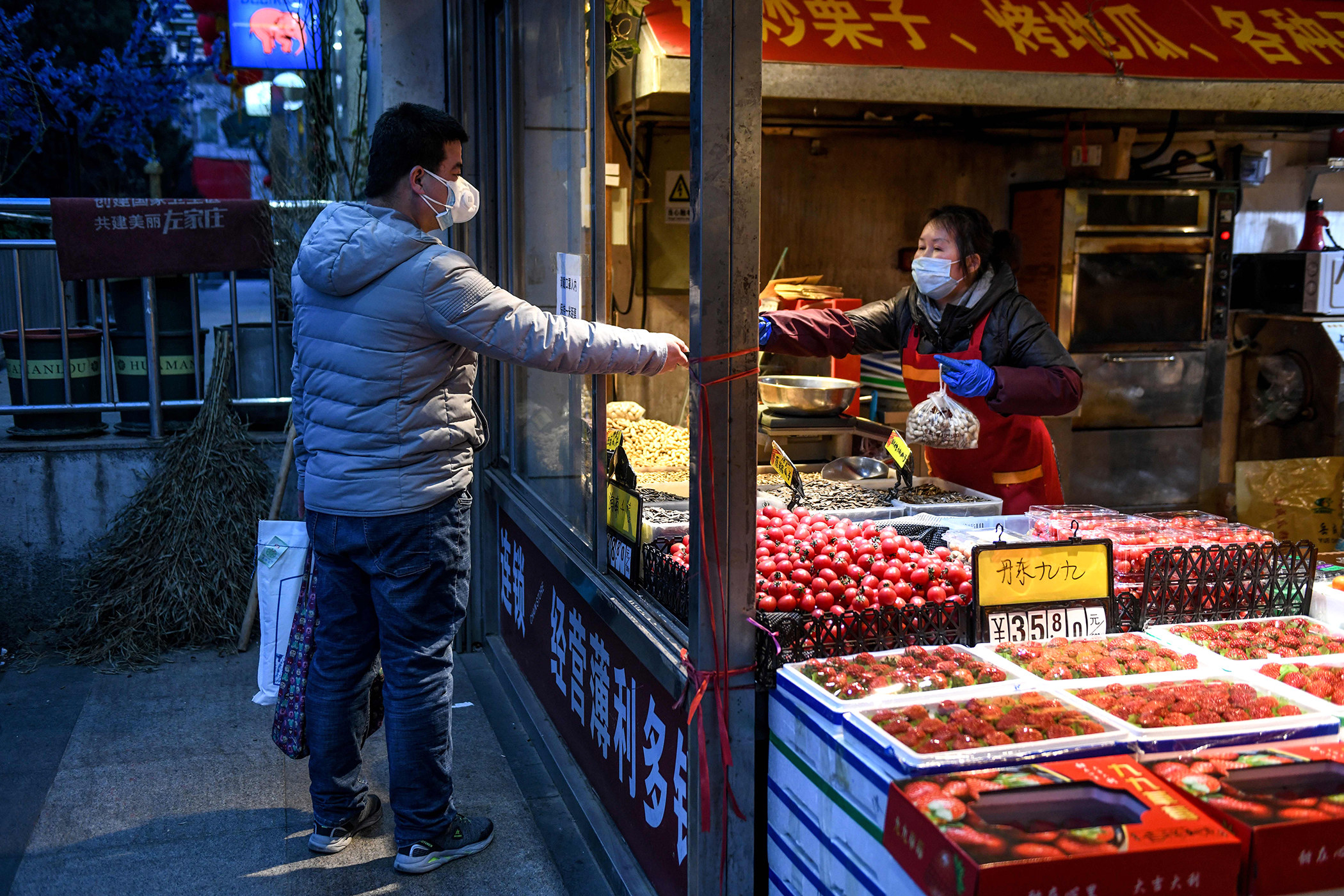
Italy circa March 10, 2020
https://www.theguardian.com/world/2020/mar/10/were-a-bit-shocked-italians-on-life-under-coronavirus-lockdown#img-1
(taken from this article: https://www.theguardian.com/world/2020/mar/10/were-a-bit-shocked-italians-on-life-under-coronavirus-lockdown )
Spain circa March 15, 2020
https://thenypost.files.wordpress.com/2020/03/1212571178.jpg
(taken from this article: https://nypost.com/2020/03/15/spains-coronavirus-death-toll-doubles-overnight-as-country-goes-into-lockdown/ )

Iran on March 4, 2020
https://i.insider.com/5e60cb83fee23d65f6415643?width=700
(taken from this article: https://www.businessinsider.com/coronavirus-iran-struggles-contain-outbreak-how-why-photos-2020-3 )
Still think it's the masks worn by the general population that are making the difference between the countries with the worst COVID-19 casualty records and those doing much better? It's not. It's aggressive testing (and re-testing), contact tracing, quarantining and quick and pervasive education.
Spread knowledge, not the virus.
Stay well, stay safe, stay sane, STAY HOME.
We're not done yet. Not nearly.
April 10, 2020
COVID-19
Warning: these posts are for 'adults'; people with the ability to think for themselves, take responsibility for their actions, and prepared to work for the greater good. If that isn't you, remember to wash your hands and face with soap regularly and don't touch anything. Stay home. The Internet has plenty of content to entertain you.
On Thursday, Canada added another 1474 confirmed cases and 74 deaths related to COVID-19. These numbers are likely still lower than reality as testing still isn't being done in sufficient numbers. There are pockets of encouraging results in BC, SK, MB, NB, PE which might be cause for some optimism. Still not the case in 3 of the 4 most populous provinces. The provinces which have flattened the curve show that the measures we keep pushing people to observe do work, despite the headlines focusing on the outbreaks. It is virtually certain Ontario is under-reporting new cases significantly due to low testing volumes.
When looking at charts, be sure to look at the left axis to see if the plot is on a liner or logarithmic scale. It makes a huge difference for interpretation. If in doubt, go back to tables of numbers.
COVID-19 is not an "Easter Miracle". The disinformation 'infodemic' is increasing in breadth and depth.
https://theconversation.com/qanon-conspiracy-theories-about-the-coronavirus-pandemic-are-a-public-health-threat-135515
Back to DIY cloth masks
Despite medical experts telling us that DIY cloth masks don't offer much, if any, protection, and providing a list of reasons why they won't be effective in real world use, it's clear that many are reading recent media articles as saying: it's OK to go out and ignore physical distancing and self-isolation if I make a cloth mask (or get one from a friend or online) and wear it. There is a term for people who think that: future patients.
While there hasn't been time to do a good study on the possible effects of using cloth masks as
a barrier against the COVID-19 virus specifically, I have found a real study that is relevant.
It was about respiratory infections and mask efficacy. COVID-19 is first and foremost a respiratory
disease (it causes a cough, infects the upper and lower respiratory systems and can cause pneumonia).
You can read the study paper here:
https://bmjopen.bmj.com/content/5/4/e006577
I really encourage you to read it.
Here's an article in lay language about that study. The headline might provide a clue.
Cloth Masks Increase Infection Risk for Healthcare Workers
https://globalbiodefense.com/2015/04/28/cloth-masks-increase-infection-risk-for-healthcare-workers/
For the TLDR crowd:
“These guidelines need to be updated to reflect the higher infection risk posed by cloth masks,
as found in our study.” [emphasis added]
"Professor MacIntyre said the study’s results pointed to the effectiveness of medical masks, in addition
to the harm caused by cloth masks." [emphasis added]
Because the authors of that report have been so inundated by people looking for loopholes, they issued
this statement on Monday, March 30, 2020.
https://bmjopen.bmj.com/content/5/4/e006577.responses#covid-19-shortages-of-masks-and-the-use-of-cloth-masks-as-a-last-resort
Note this study was based on healthcare workers, who are trained on how to use personal protective equipment - including masks.
COMMENTARY: Masks-for-all for COVID-19 not based on sound data
(CIDRAP is the Center for Infectious Disease Research and Policy, and this article is written by two researchers who work in the field.)
https://www.cidrap.umn.edu/news-perspective/2020/04/commentary-masks-all-covid-19-not-based-sound-data
This is about the health of people who will be using the mask you make or furnish, maybe even you.
And even if the DIY cloth mask could work in theory, practice is a different matter. I have seen people
wearing cloth masks in recent days. They're doomed to fail based on what I have observed and researched.
a) a cloth mask does not cover your eyes, which is an entry point for the virus
b) you will make your mask from the wrong material, so it will not effectively block the virus, but if you do
come in contact, it will keep the virus right against your face and nurture it for a few hours
c) you will not put it on correctly to reduce face touching as you have not been trained to do so
d) you will not wear it correctly (based on the vast majority I have seen in use in person and in photos)
e) you will adjust it and fiddle with it, increasing the number of times you touch your face
f) you will not remove it correctly leading to spreading of the virus if exposed while wearing it
g) you will not store it correctly before and after use
h) you will not dispose of it correctly when finished with it (they're already showing up on the ground)
i) you will use it multiple times before it is cleaned, sterilized and dried thoroughly, increasing infection risk
j) it probably won't fit you properly, so the virus can reach your nose or mouth at the openings around the edges
k) you will violate physical distancing rules because you now have a false sense of security and were just looking for a loophole anyway
l) you are more likely to contract an infectious respiratory disease because you are wearing a cloth mask (read the study)
If you do have symptoms, just stay home. The DIY cloth mask won't help you. You already have the symptoms. Call your local health authority to schedule a test. Follow their instructions PRECISELY.
More papers on effectiveness of cloth masks for infection control.
https://www.researchgate.net/publication/258525804_Testing_the_Efficacy_of_Homemade_Masks_Would_They_Protect_in_an_Influenza_Pandemic
[dead link: https://www.ijic.info/article/download/11366/8308
https://blogs.bmj.com/bmj/2020/03/11/whos-confusing-guidance-masks-covid-19-epidemic/
Still more to come on cloth masks.
Spread knowledge, not the virus.
Stay well, stay safe, stay sane, STAY HOME.
We're not done yet. Not nearly.
April 9, 2020
COVID-19
Warning: these posts are for 'adults'; people with the ability to think for themselves, take responsibility for their actions, and prepared to work for the greater good. If that isn't you, remember to wash your hands and face with soap regularly and don't touch anything. Stay home. The Internet has plenty of content to entertain you.
Despite Ontario reporting another record number of confirmed cases and still not doing enough testing, and a higher number of cases in Canada on Wednesday than on Tuesday, looking at the trend line, the reported number of new cases for Canada appears to be deflecting gradually towards flattening the curve. The Canadian ratio of deaths to reported cases is still rising. The reporting issues in Ontario still concern me, but otherwise let's take the slowing of the increase in daily numbers as new motivation to stick with what works: isolation, physical distancing, washing our hands, disinfecting surfaces, cough or sneeze into your elbow, maintain social contact at a distance, staying home.
I came across this idea yesterday. If you don't already keep a calendar of all your meetings
and activities, consider creating a log for the short term of where you go each day, including
unscheduled / unexpected stops and meetings, identifying people you know (initials which you
will recognize are efficient and sufficient). That way, if it turns out you do test positive
at some point in the future, this will help people trying to trace your possible contacts.
This is also one reason authorities want people to make expenditures with credit or debit cards;
it makes establishing timelines easier and more accurate. (There are personal privacy issues
involved here. Having a good log ready if needed may mean the tracing folks won't need access
to your credit and debit transaction records.) Which doesn't diminish the value of reducing
contact and possible virus transmission via reducing handling cash. Making event logs is
something I do for every project I manage, so I have built some templates for you to use in
case you think this idea has merit.
Spreadsheet version (.XLS) https://www.econogics.com/COVID-19EventLog.xls
Spreadsheet (.CSV) https://www.econogics.com/COVID-19EventLog.csv
Word processor version (.DOC) https://www.econogics.com/COVID-19EventLog.doc
Paper version (.PDF) https://www.econogics.com/COVID-19EventLog.pdf
Simple text version (.TXT) https://www.econogics.com/COVID-19EventLog.txt
(Remember to remove the example from the template once you have entered a record, and keep at
least the most recent 3 weeks of information.)
An update from the Canadian COVID-19 Community Care Fund ( https://www.canadahelps.org/en/cause-funds/covid-19-community-care-fund) says they have raised over $370,000 in a week, and matching funds remain available from the Gore Mutual Foundation. Over 400 charities providing various services to support communities benefit from this fund.
Language matters. Let's take care about what we say and how we say it. I am seeing a number
of elected leaders comparing the current pandemic - and especially local effects - in terms we
normally reserve for war. This causes me concerns on a number of levels, not the least of
which is that it lays the ground for acceptance of more authoritarian measures. That in turn
will reduce the opportunities for localized solutions, which is how communities naturally respond.
We're seeing small businesses retool to make face shields and hand sanitizer and local service
organizations stepping up to support seniors and others at home with mobility and health issues.
We're seeing individuals take on organizing resources like finding idle RVs to house health care
workers who are going to work despite risks but wanting to protect their families by not going home.
https://www.cbc.ca/news/canada/windsor/rv-health-care-workers-windsor-1.5525913
Those are acts of love and compassion, not aggression and violence. COVID-19 isn't an armed force storming our shorelines. It's a disease and this is a health emergency. We don't need rifles and ammunition, we need personal protective equipment and ventilators - and research to develop an effective treatment to cure people who have been infected.
I have an additional concern; this cavalier use of war terminology trivializes war and the
horrors and costs that it brings. Each November, we vow to Never Forget, not just the sacrifices
but also the carnage and horrors so we won't repeat them. Let's take our language cues
from our medical experts, not warmongers inserting themselves into a conversation they
don't understand. Another take here:
https://theconversation.com/war-metaphors-used-for-covid-19-are-compelling-but-also-dangerous-135406
If you are looking for a better understanding of the COVID-19 (SARS-CoV-2) coronavirus in
fairly concise form, have a look at this 4-pager.
https://arxiv.org/ftp/arxiv/papers/2003/2003.12886.pdf
For a more intensive dive into COVID-19 topics, MedCram has 3 free courses listed related
to COVID-19 (Pandemic, Ventilator, Lung Ultrasound).
https://www.medcram.com/collections?category=covid-19-SARS-CoV-2
There are still lots of threats for new work-from-home folks as Internet bandwidth consumption continues to increase. Broadband bandwidth is a shared resource, so during 'business hours', please try to ramp down your consumption a bit. Plain-text emails, turn off video-feeds on Internet conference meetings, set your browser to not automatically download remote images, choose low-res images when they are sufficient, edit documents locally instead of online ... and generally exercise good Internet hygiene. In the era of the COVID-19 virus, you should be avoiding computer viruses and malware, too.
Find a tool other than Zoom for your video-conferencing.
https://www.cbc.ca/news/technology/taiwan-zoom-video-conference-1.5524384
Once again, Lynn Greiner's recent article on other options:
[dead site: https://www.itworldcanada.com/article/suddenly-working-from-home-and-need-a-solution-that-works-here-are-some-options/428618]
Blackberry unmasks another cyberthreat vector from China - this time it's Linux under attack.
https://www.forbes.com/sites/daveywinder/2020/04/07/linux-security-chinese-state-hackers-have-compromised-holy-grail-targets-since-2012/#3eac06bb2086
Only a little space today for more on DIY cloth masks. (probably already hit the TLDR limit)
Does this sound familiar yet? Avoid touching your face.
When you put a mask on, you will touch your face. When you take the mask off, you will touch your face. Dozens of times in between those events, you will fiddle or adjust your mask, and touch your face. The advice from experts for breaking the transmission chain is: DON'T TOUCH YOUR FACE!
The mask you make at home will NOT be a surgical mask. I am beginning to think that even the mainstream media is deliberately blurring the difference between a real surgical mask and a DIY (do-it-yourself aka home-made) cloth mask to create a story out of disinformation or to cater to the 'social media' feeding frenzy on making your own masks. Or, perhaps the mainstream media don't understand the difference themselves?
It is virtually impossible that you will have the proper material for making a surgical
mask at your disposal. Do you even know what material that is?
http://www.maskmaterial.com/article/35/
https://business.financialpost.com/news/economy/brutal-education-inside-the-mad-rush-to-make-masks-to-battle-covid-19
In case I haven't been clear: a DIY cloth mask IS NOT a surgical or procedure mask. It does not provide the same protection, if any at all. The key material for an effective surgical mask is essentially unobtainable now to end consumers.
Don't go out over the Easter weekend to visit family and friends thinking a cloth mask will protect you or them from the COVID-19 virus. It won't.
To be continued ...
Spread knowledge, not the virus.
Stay well, stay safe, stay sane, STAY HOME.
We're not done yet. Not nearly.
April 8, 2020
COVID-19
Warning: these posts are for 'adults'; people with the ability to think for themselves, take responsibility for their actions, and prepared to work for the greater good. If that isn't you, remember to wash your hands and face with soap regularly and don't touch anything. Stay home. The Internet has plenty of [dead link: https://www.thedrive.com/the-war-zone/32853/this-venezuelan-patrol-ship-sunk-itself-after-ramming-a-cruise-liner-with-an-reinforced-hull] content to entertain you.
Canada reported 1205 new confirmed COVID-19 cases on April 7 and 52 deaths. Both figures indicate increases in rate relative to recent numbers, though the rate of increase for new cases is slowing very slightly. This mostly reflects the better recent numbers out of BC and a dramatic one-day drop in AB which is out of line with their recent trend line. The virus is still winning on the numbers, and the Easter long weekend could entice more people to cheat on their isolation, potentially fuelling a new crest in numbers in a couple of weeks.
I recognize that the federal government is revving up to churn out a pile of money to Canadians adversely affected by COVID-19 via Employment Insurance, the 75% wage support to businesses via the Canada Emergency Wage Subsidy (CEWS), and the Canadian Emergency Response Benefit (CERB). I also think their flexibility to add in more groups as they feel their way through the various impacts is a mature acknowledgement that they don't know all the answers and corner cases from the get-go. I'm looking forward to seeing how supports work for students watching their summer employment plans evaporate.
However, I'm just going to point out a couple of things I see as a possible missed opportunity. According to the Prime Minister on April 5, (https://globalnews.ca/news/6780556/coronavirus-canada-trudeau-update/) 'Health Canada will be building “an inventory of specialized work volunteers” that provinces and territories can draw on, and that some of the work may include tracking COVID-19 cases and tracing contacts'.
Given we likely have a bunch of under-utilized people who are about to start collecting EI and CERB benefits, why wouldn't we align the need for specialized skills (such as students from late April to September, including those studying medicine, paramedic skills, lab skills, other health care disciplines, logistics and administration), so they can be paid to do the work Health Canada is looking to have done by volunteers? Or create work for those impacted by COVID-19, but don't qualify for EI or CERB or wage support benefits?
I have connections to a number of organizations which rely on volunteers to provide community services and they don't suggest that they have too many. (Some are looking for more volunteers as a result of COVID-19.) Also, many volunteers are not looking for an unpaid full-time job. COVID-19 is already stressing community support organizations, so pulling away their current volunteer base seems counterproductive to me on a societal basis. Creating paid employment for those who want it just seems like a path worth exploring.
This piece speaks to who is being left out by the current programs, and the possible
implications of that.
[dead link: https://www.broadbentinstitute.ca/angellamacewen/covid_19_emergency_benefits_who_s_included_who_s_left_out_and_the_role_of_provinces]
I know there are people who think any such generosity will be abused. Here's my take.
1) We're calling it an emergency. Is it only an emergency for some of the people who are
seriously impacted?
2) It's a health emergency. We want people to isolate to prevent virus transmission.
Leaving a large number of Canadians without support does not align with that short-term objective.
3) All the benefits are taxable. If someone really does well out of the benetts (which I have
trouble imagining with the caps on the programs), they'll just get to pay it back next April.
Remember, CRA is the mechanism for doling out the money. They'll know who received it.
4) We're trying to rescue an entire economy here - not just one sector. A few extra dollars to
those qualifying individuals for up to $2,000 a month for 4 months aren't going into bank accounts
in the Caymans (which may be more than I can say for the still-expected mega-billions bailout to
the oil industry because Alberta's $7 billion clearly isn't enough to satisfy the infinite greed
of the already-taxpayer-subsidized oil industry. Alberta Energy Minister Sonja Savage is convinced
Bill Morneau's going to deliver big bucks to the doomed Canadian oil industry, possibly as soon as
today. Because the aid packages offered to all other businesses in Canada just aren't enough to
satisfy the bitumen patch.
https://www.cbc.ca/news/business/ottawa-package-for-canadian-oilpatch-1.5524551
Well, at least Jason Kenney's big spend is going to create jobs in the short term - in Montana.
Not so much in Alberta.
[dead link: https://www.nytimes.com/aponline/2020/04/07/business/bc-us-keystone-xl-pipeline.html]
https://www.nytimes.com/aponline/2020/04/07/business/bc-us-keystone-xl-pipeline.html)
5) When the economy starts to pick up again 'after', it's not going to happen overnight or evenly.
The CERB will need to be flexible enough to allow people to go off it gradually. If we want success,
we don't want people turning down half-time work because it terminates all their CERB benefits
immediately. We will want a CERB exit strategy that provides the best chance for success, even if
that includes ramping up as the economy recovers.
While we're talking about government policy related to COVID-19 impacts, how about a commitment
from all levels of government in Canada to secure sources of supply within Canada for critical health
items starting now? A lot of of Canadians, individuals and businesses - mostly small businesses - have
been stepping up to help address the current supply crisis, in some cases without even getting calls
returned by government officials scrounging for the very gear on offer.
https://artisandistillers.ca/news/artisan-distillers-disinfectant
https://www.ctvnews.ca/lifestyle/article/mask-suppliers-say-they-have-ppe-available-and-not-at-inflated-prices/
https://www.theglobeandmail.com/business/article-how-canadian-companies-are-transforming-to-meet-demand-on-pandemic/
[paywalled: https://www.thestar.com/politics/provincial/2020/04/07/ford-touts-ontario-made-n96-mask-similar-to-the-n95-gear-used-to-fight-covid-19-and-held-up-by-trump.html"]
https://vancouversun.com/news/local-news/covid-19-coquitlam-company-retools-will-be-first-in-canada-to-produce-n95-respirators/wcm/fe108057-63db-4dfe-835a-b625afa4aea5/
https://www.cbc.ca/news/canada/kitchener-waterloo/ontario-health-orders-300k-face-shields-from-kitchener-company-inksmith-1.5523747
https://www.kitchenertoday.com/coronavirus-covid-19-local-news/local-company-looking-to-make-25000-face-shields-per-week-2234431
https://www.trucknews.com/health-safety/truck-driver-launches-group-producing-covid-19-face-shields/1003139162/
https://www.cbc.ca/news/politics/ventilators-trudeau-1.5524581
https://business.financialpost.com/transportation/ottawa-orders-made-in-canada-ventilators-surgical-masks-covid-19-tests-in-rush-for-supply
https://www.cbc.ca/news/canada/calgary/okotoks-alberta-owen-plumb-3d-printing-face-shields-covid-19-1.5522924
There are more such stories, and I expect more to come. That's one positive sign from the COVID-19 ordeal.
Given our governments and multi-national corporations chose to essentially offshore most of our manufacturing to low-wage countries over the past couple of decades and hollowed out manufacturing capacity in Canada, I'm pleasantly astonished at the progress that has been made in a matter of days by Canadians answering the call to support their neighbours. It would be brilliant for us all if that action was rewarded in the months and years to come, rather than punished.
This is happening while companies based in other countries are profiteering at the expense of Canadian taxpayers, or are being blocked from shipping product they were contractually obligated to deliver. In fact, this is a wake-up call for all of us that Canada needs to support value-add businesses in Canada so we can actually get the end-products we need in times of global scarcity. I understand Canada is a trading nation, and a signatory to a lot of international 'free-trade' agreements. However, when other countries make it clear they don't feel bound by those agreements as soon as they are inconvenient (remember softwood over the decades, and random Tariff-man trade tantrums for the past 3 years), we need to recognize the need for a Plan B for critical products and equipment.
We also need to live up to our policies of having inventories of unexpired materiel within our borders. Once the current panic has passed for such products, we need government support via agencies like EDC to help establish on-going export markets for these products, so these businesses can survive when future conservative governments choose to undermine them at home.
With major aspects of PPE supplies for front-line medical workers possibly coming under control in
Canada, take note of the next scarcity issue being faced in the UK: oxygen.
https://www.hsj.co.uk/oxygen-supply-problems-the-new-ppe-warn-hospital-bosses/7027333.article
Expect an uptick in the number of COVID-19 cases in Canada starting 1-2 weeks from now as, just in
time for Easter, the mainstream media misrepresent what the senior officials are saying and people will
start wearing DIY cloth masks believing they offer protection against catching the COVID-19 virus.
This is what those officials are actually saying:
https://globalnews.ca/news/6786043/bonnie-henry-coronavirus-mask/
https://www.canada.ca/en/health-canada/services/drugs-health-products/medical-devices/activities/announcements/covid19-notice-home-made-masks.html
The current emergency is not a justification for defective PPE being supplied. That's just going
to lead to more people getting sick.
https://www.ctvnews.ca/toronto/article/defective-masks-were-sent-to-toronto-long-term-care-home-where-residents-died-of-covid-19/
As best I can tell, this story is true. I nominate it for the dumbest thing I have heard so far
related to the COVID-19 period, including White House disinformation sessions.
https://www.thedrive.com/the-war-zone/32853/this-venezuelan-patrol-ship-sunk-itself-after-ramming-a-cruise-liner-with-an-reinforced-hull
Really? Somebody was trying to hijack a cruise ship in the era of COVD-19?
That's the space for today. Perhaps I'll get back to DIY cloth masks tomorrow.
Spread knowledge, not the virus.
Stay well, stay safe, stay sane, STAY HOME.
We're not done yet. Not nearly.
April 7, 2020
COVID-19
Warning: these posts are for 'adults'; people with the ability to think for themselves, take responsibility for their actions, and prepared to work for the greater good. If that isn't you, remember to wash your hands and face with soap regularly and don't touch anything. Stay home. The Internet has plenty of content to entertain you.
Today is National Caregivers Day in Canada. Take a moment to think of those caring
family members and friends who are tending to the frail and vulnerable today, hoping they
are neither going to be exposed to COVID-19 or transmitting it while volunteering to
provide care. If you know someone filling this role who could use some support, have a
look at [dead site: https://www.huddol.com] Huddol.com to benefit from their Caregiver Community Fund. Related:
https://business.financialpost.com/pmn/press-releases-pmn/business-wire-news-releases-pmn/teva-canada-committed-to-canadian-caregivers
Canada's number of reported cases is still increasing day over day - the opposite of flattening the curve. Canada's ratio of deaths to reported cases has risen to about 2%. The total number of new cases reported on April 6th was lower than April 5th. It's too soon to declare a win here. The drop number is small. One big flare-up or a big increase in reporting test results could easily reverse the direction. One day does not make a trend. Other than in BC (possibly), it is clear too many Canadians were not working to break the transmission chain a week to two weeks ago. Based on news headlines, this was still the case this past weekend in many parts of Canada.
An update from Folding@Home, for those of you who are throwing compute power at beating
the COVID-19 coronavirus. Progress is being made.
https://foldingathome.org/2020/04/03/capturing-the-covid-19-demogorgon-aka-spike-in-action/
Back to DIY cloth masks
I'm open to good data / facts / evidence on this topic. So far, I'm seeing even experts leap from facts to speculation when they talk about a place for DIY cloth masks for the uninfected. There is evidence that there are some asymptomatic people who have tested positive for the COVID-19 virus, without defining asymptomatic (is it truly people who were clinically tested with zero symptoms, e.g no fever at all, or just subtle enough that the individual can hide them?)
Then there is the assumption that truly asymptomatic individuals are shedding significant
viral loads, and that they are spreading them further than the 2-metre (6-foot) physical distancing
recommendation. But note, in every item I have read so far (dozens) they are speaking of documented
transmission "between people interacting in close proximity".
[original link has been removed by CDC: https://www.cdc.gov/coronavirus/2019-ncov/prevent-getting-sick/cloth-face-cover.html]
however, this item that referenced the April 3rd, 2020 recommendation is still available:
Factors Associated with Cloth Face Covering Use Among Adults During the COVID-19 Pandemic — United States, April and May 2020.
Sorry if it looks like an anachronism.)
If you are physically distancing and not having symptoms, you don't need a mask.
Yesterday, Dr. Theresa Tam (Public Health Agency of Canada) was reported to have said
(quoting the article):
Wearing a simple cloth mask is a way for someone who might have COVID-19 without realizing it to
avoid spreading the illness to others, Canada's top public-health doctor said Monday.
Dr. Theresa Tam said the new advice, a shift from previous instructions, flows from increasing evidence that people with the virus can spread it without knowing they're sick.
"Masks worn this way protect others rather than the people wearing them, and don't exempt wearers from all the other measures they should take against COVID-19, including physical distancing and regular handwashing, Tam said during a media briefing by federal officials. (emphasis added)
I'm going to unpack that a bit before the onslaught from 'social media' tries to tell you that the Public Health Agency of Canada has recommended or approved the use of DIY cloth masks as a way of protecting you from infection. (Actually, I'm too late, those memes are already in 'social media' and in the headlines for articles in mainstream media.)
Dr. Tam did not say the cloth mask would protect people from the COVID-19 virus. She said: "Wearing a non-medical mask in the community has not been proven to protect the person wearing it. It is an additional way that you can protect others."
It's not even completely or highly effective against transmission from an infected person.
She said: "A non-medical mask can reduce the chance of respiratory droplets coming into contact with
other people or surfaces -- for instance, on a bus or at the grocery store."
[dead link: https://www.ctvnews.ca/health/coronavirus/non-medical-masks-can-keep-people-with-covid-19-from-spreading-it-tam-says-1.4884484]
In short, a DIY cloth mask is not "approved" or "recommended" by PHAC. PHAC says they provide no protection to someone who does not have the virus. PHAC says it MAY provide some reduction in transmission if worn properly by someone who is currently infectious, but absolutely not complete protection. PHAC says a mask does not reduce the need for other COVID-19 countermeasures such as isolation, physical distancing, washing your and hands and avoiding touching your face. PHAC is still concerned that wearing a mask will create a false sense of security, thereby increasing the risk of transmission. That's not really a shift in guidance; it's just addressing the DIY cloth mask elephant crowding everything else out of the room.
Still, many Canadians will now think they now have their loophole and it's OK to dispense with isolation and physical distancing if they wear a mask. That's incorrect, and dangerous. The starting point for this conversation should be: if you think you might be infected or contagious, stay home. The supposed value of the DIY cloth mask is that it MAY reduce the transmission of the virus if worn by the infected person. If you think you might be infected, stay home and call local health officials to schedule a test.
If you are infected, and if you are shedding the virus, and if the mask is effective at reducing the spread of the virus to others, it is because the live virus is trapped in the mask, ON YOUR FACE.
This is better than staying isolated? I don't think so.
To belabour an important point on transmission. The entry points are mouth, nose, eyes. That's why the advice is to avoid touching your face. A cloth mask does not protect your eyes. If someone does transmit the virus to you and the mask stops it from reaching your nose or mouth, the mask is holding the virus against your face, and you WILL touch it with your hands, or your breathing may eventually pull the virus through the mask into your nose or mouth. That's not better than distancing.
If we're really concerned about protecting the uninfected from these posited outlier hazards
of COVID-19 transmission, then we should not be stopping at cloth masks, which do not protect
the eyes and do hold live virus against your face.
[dead link: https://www.cdc.gov/coronavirus/2019-ncov/prevent-getting-sick/cloth-face-cover.html]
https://www.cdc.gov/coronavirus/2019-ncov/prevent-getting-sick/cloth-face-cover.html
https://www.snopes.com/news/2020/04/04/why-wear-face-masks-in-public-heres-what-the-research-shows/
Instead, we should be making helmets with very fine filters for air intake which do not overly cross with air being exhaled. Or at the very least, simple DIY face shields. But we're not. Because that would be crazy. Right?
DIY face shields - any value? Have a look at this link:
https://www.econogics.com/DIY_Face_Shields.html
More on masks again tomorrow. Dr. Tam and the media hijacked today's blog entry.
Spread knowledge, not the virus.
Stay well, stay safe, stay sane, STAY HOME.
We're not done yet. Not nearly.
April 6, 2020
COVID-19
Warning: these posts are for 'adults'; people with the ability to think for themselves, take responsibility for their actions, and prepared to work for the greater good. If that isn't you, remember to wash your hands and face with soap regularly and don't touch anything. Stay home. The Internet has plenty of content to entertain you.
Monday, Monday - Can't trust that day.
Quebec set a new record for new confirmed cases on Sunday, for the second day in a row. Ontario posted it's 3rd highest count yet. As a whole, Canada reported its 2nd highest daily count for new confirmed cases to date. It might actually be worse than that, because some provinces did not report on Sunday, or showed unexpectedly low new counts. We're likely s eeing the low Sunday reporting we have seen in past weeks.
Still, I see stories of people who figure COVID-19 isn't a risk for THEM, so they're really put out about these inconveniences being imposed. Living in a society with all the benefits that offers to individuals comes with the obligation to support that society. I fear we really will have to start jailing some people before they get the message. It seems even fines are not delivering the point forcefully enough. Looking for loopholes at this point is not socially acceptable behaviour.
I also see some stating that this disease isn't so bad, lots of people are recovering.
Surviving this infection is not necessarily a party. It's great if you find out you tested
positive but your symptoms were mild or hardly even noticed. I'm very happy for people like that.
It's not always the case. To get a sense of how awful COVID-19 can be, even for survivors,
please read this piece.
https://www.nytimes.com/2020/04/05/magazine/first-coronavirus-patient-new-jersey.html
COVID-19 is about people. People who get sick. People who die. People mourning. People working every day in health care, shadow health care, providing care for others at home. People keeping the supply lines for food, medicine and other essentials flowing. People doing check-ins (preferably by phone or Internet) on the vulnerable (and we should define that VERY broadly). People keeping essential services - including the Internet and hauling away our trash - functioning well. People working from home (which isn't always low-stress). People reaching out to help others even in small ways. People sharing a bit of humour. Even those people just doing what they're asked to break the transmission chain: stay home, isolate, physical distancing, washing hands, avoid touching face, disinfecting.
Caremongering
https://globalnews.ca/news/6765383/alberta-rv-donations-health-care-workers-self-isolation/
https://globalnews.ca/news/6729252/coronavirus-caremongering/
https://www.cbc.ca/news/canada/ottawa/ottawa-helps-volunteer-donate-covid-19-1.5500597
[paywalled: https://www.thestar.com/opinion/editorials/2020/03/22/caremongering-a-movement-that-amplifies-the-best-of-us.html]
https://ottawacitizen.com/news/local-news/those-in-need-find-those-who-help-in-ottawa-covid-19-community-care-facebook-group/
Canadians are making the news outside Canada for this.
https://www.washingtonpost.com/opinions/2020/03/24/canada-an-inspiring-movement-emerges-response-coronavirus/
https://www.bbc.com/news/world-us-canada-51915723
There are great ideas in the items above. What can you do to support others?
Once again I'm going to caution against the casual use of do-it-yourself (DIY) cloth masks (and making them). (See also my post from March 28, 2020).
I recognize the desire to do SOMETHING to strike back against an invisible virus. It's part of why I'm putting out these blog posts each day. It's frustrating and tedious and for many, stressful. I applaud people who are doing the boring stuff they are being asked to do to break the transmission chain.
I also see that even some governments are signalling some tolerance on DIY cloth masks. I'm not. I have researched this a lot since early March, and the evidence I can find says the real health benefits aren't there for people who are not infected to wear the DIY cloth masks. Cloth masks are not what health care workers want. Think about why that is. (Hint: they're looking for real protection, not a loophole.)
Unfortunately, the 'social media' meme is unrelenting, so we need to swim against the current on this one.
IF you see a local health organization asking for DIY cloth masks, then by all means, follow their instructions precisely and have at it. Ensure the request is from the actual organization that wants the DIY cloth masks. Not based on a 'social media' post by someone not associated with the health organization. Health organizations have websites. Check there first.
However, if you do that search for local health organizations that want DIY cloth masks, I think
you will be more likely to find stories like this from hospitals and health professionals.
https://www.cbc.ca/news/canada/ottawa/kingston-general-hospital-homemade-masks-covid-19-1.5520752
And while the headline to a story might be "Some experts are shifting their advice", if you read the
actual story, they really aren't.
https://www.thestar.com/news/canada/2020/04/03/should-we-all-wear-masks-to-slow-covid-19-some-experts-are-shifting-their-advice.html
They're continuing to say stay isolated, practice physical distancing, continue good hygiene,
avoid touching your face. Then, in response to pressure and questions, they address the cloth
mask. Understand their message is essentially: wearing a DIY cloth mask doesn't make it OK to
disregard those measures that actually work.
This text comes from an Ottawa store that sells sewing supplies (or did until March 23rd).
"Similarly, it appears there is a general opinion the home made face masks are at least better
than nothing since there has been none in stores to buy for weeks, and this virus is probably going
to be around for a while. Please be aware, however, they are not a protection against the virus
and are not adequate for health care workers. Please do not show up to hospitals with home made masks.
This link provides Canada's official position: Health Canada Notice to General Public and Healthcare
Professionals"
The link to the store's website (so you can read this for yourself):
https://www.sew-jos.ca/
The link the store pointed to:
https://www.canada.ca/en/health-canada/services/drugs-health-products/medical-devices/activities/announcements/covid19-notice-home-made-masks.html
(The store website does note a local (Ottawa) need for an item which can be sewn at home. NOTE: Sew Ottawa is a closed Facebook group, so I can't validate the call for gowns or the existence of the pattern. I do not see anything on the actual Hospice Ottawa website (https://www.hospicecareottawa.ca/) showing they are asking for these cloth gowns.)
Again, please, make sure you have a defined recipient for cloth masks (or whatever you may be able to make at home), know exactly what they want and how you will get it to them before buying supplies or threading a needle.
There definitely are positive things you can do from home to help out others.
For many years, I have been aware of local organizations making quilts for people with medical conditions.
http://quiltsforcancer.ca/
If you have cotton fabric which could be used for cloth masks, you could be making piecework quilt tops.
Even small ones can be used.
E-mail or call for more information before starting a quilt for them.
https://blankets4canada.ca/
Just because COVID-19 is a headline story these days, doesn't mean other diseases or injuries have
stopped. And people are still having babies, and baby quilts are great gifts.
Once upon a time, I even made quilts as window insulation. Perhaps you could do something like
that for yourself and reduce your future heating and air conditioning bills.
http://www.econogics.com/busys/wnquilt.htm
If you knit or crochet, there is still demand for donations for preemies and others dealing with
illness and other issues.
https://warmhandsnetwork.org/
[dead link: http://www.angelhugs.ca/]
https://littleredwindow.com/where-to-donate-baby-hats-to-charity/
Connect with any of them before you start a project. There are undoubtedly other similar local groups, possibly near you. I have just scratched the surface here with a quick Internet search. Others can do the same. You can make a positive difference while stuck at home (or even if you're not).
'Social media' is really pushing the recent item out of the CDC (U.S.) as justification for using
DIY cloth masks.
[dead link: https://www.cdc.gov/coronavirus/2019-ncov/prevent-getting-sick/cloth-face-cover.html]
https://www.cdc.gov/coronavirus/2019-ncov/prevent-getting-sick/cloth-face-cover.html
Those 'social media' posts aren't so much noting this text from the CDC release:
"CDC recommends wearing cloth face coverings in public settings where other social distancing measures
are difficult to maintain"
What that means is: STAY HOME, observe PHYSICAL DISTANCING guidelines. It doesn't mean that its fine
to go out and socialize because now you have a cloth mask.
I'll continue on the DIY cloth masks story tomorrow.
Share knowledge, not the virus.
Stay well, stay safe, stay sane, STAY HOME.
We're not done yet. Not nearly.
April 5, 2020
COVID-19
Warning: these posts are for 'adults'; people with the ability to think for themselves, take responsibility for their actions, and prepared to work for the greater good. If that isn't you, remember to wash your hands and face with soap regularly and don't touch anything. Stay home. The Internet has plenty of content to entertain you.
Don't spread disinformation. Don't spread germs. So far in Canada, the disinformation is still the more dangerous of the two.
Canada's rate of infection and deaths trend lines appear to be still accelerating. Quebec had it's single largest one-day increase in confirmed cases yesterday (April 4).
Today (April 5), more Ontario businesses are required to close as it is clear that past measures were not sufficient to stem to the tide of rising infections. More people out of work for a while, which is necessary.
If you are looking to get some relief from the federal government's Canada Emergency Response Benefit (CERB), and your birthday is in January, February or March, then tomorrow (Monday, April 6th, 2020 or subsequent Mondays) is your day to apply for benefits.
If your birthday is in April, May or June, Tuesdays are your day. If your birthday is in July, August or September, Wednesdays are for you. Otherwise, it's Thursdays for the last quarter of the year. Fridays, Saturdays and Sundays are a free-for-all.
How do you know if you will qualify? Here's what the government website says:
Eligibility
The benefit will be available to workers:
• Residing in Canada, who are at least 15 years old;
• Who have stopped working because of COVID-19 and have not voluntarily quit their job;
• Who had income of at least $5,000 in 2019 or in the 12 months prior to the date of their application; and
• Who are or expect to be without employment or self-employment income for at least 14 consecutive days
in the initial four-week period. For subsequent benefit periods, they expect to have no employment income.
The Benefit is only available to individuals who stopped work involuntarily as a result of reasons related to COVID-19.
If you are looking for a job but haven’t stopped working because of COVID-19, you are not eligible for the Benefit.
More information is available at:
There are benefit programs from the provinces as well. I have noted the Broadbent Institute
list before, but it's still the best I have seen.
[dead link: https://www.broadbentinstitute.ca/covid-19]
Also from the Broadbent Institute, this is a March 25th story from Press Progress on an Ontario
health care story you likely have not seen in the Canadian mainstream media.
https://pressprogress.ca/ontario-used-emergency-powers-to-contract-out-unionized-hospital-jobs-experts-say-it-will-compromise-care/
Caremongering
https://www.ctvnews.ca/ottawa/article/wu-tang-clan-ottawa-residents-donate-170000-to-ottawa-food-bank-in-one-day-during-covid-19-pandemic/
The lists of things people can do to help tend to be very local. If you want to help others, look
for such opportunities online. Remember the objective is not a personal recreation opportunity,
but to help while still observing the key rules around isolation and physical distancing.
More threats to the work-from-home population
I'm hearing and seeing more stories about Zoom-bombing (hijacking). A CTV story.
https://bc.ctvnews.ca/zoom-bombing-beware-of-video-conference-hijacking-1.4881519
The Globe and Mail: Elon Musk's SpaceX bans Zoom use over privacy concerns.
https://www.theglobeandmail.com/business/technology/article-elon-musks-spacex-bans-zoom-use-over-privacy-concerns/
I recommend seeking alternatives. Here's a piece by Lynn Greiner to get you started on that search, including some freebies.
[dead site: https://www.itworldcanada.com/article/suddenly-working-from-home-and-need-a-solution-that-works-here-are-some-options/428618]
If you have some enforced idle time these days, perhaps you could set aside 15 minutes a
day to learn more about your world. Something other than COVID-19. There are so many things
to learn (and unlearn). For instance, did you know that the 'Spanish Flu' did not originate
in Spain? The U.S. army says it began in the state of Kansas, on one of their military bases.
[dead link: https://www.army.mil/article/188078/scientists_learn_history_of_spanish_flu_at_fort_riley]
Should we be calling it the Kansas Flu instead?
(2024 update: of course, in the current disinformation age, a story like this HAD to be linked to a
vaccine hoax on the world's great disinformation engine ('social' media). Fortunately, this one was
addressed and debunked
A meningitis vaccine trial at a U.S. military camp did not cause the 1918 Spanish Flu.
Or read a book. Shock Doctrine by Naomi Klein could help you to understand some of the context of what you see (and not see) happening today.
'Wash your hands with soap and water' presumes that everyone has access to soap and safe, clean water.
Canada still has a lot communities without reliable access to safe drinking water on tap.
Another disconnect for us to think about during this abnormal time with a view to how things should
be 'after'. In the short term, have a look at what the Council of Canadians has to say on the subject.
https://canadians.org/water
Share awareness, not the virus.
Stay well, stay safe, stay sane, STAY HOME. We're not done yet. Not nearly.
April 4, 2020
COVID-19
Warning: these posts are for 'adults'; people with the ability to think for themselves, take responsibility for their actions, and prepared to work for the greater good. If that isn't you, remember to wash your hands and face with soap regularly and don't touch anything. Stay home. The Internet has plenty of content to entertain you.
Don't spread disinformation. Don't spread germs. So far in Canada, the disinformation is still the more dangerous of the two.
Canada's rate of increase in new cases dropped yesterday (not actual number of cases). One day of data does not make a trend, in particular this datapoint may reflect less test results from Ontario on Friday after seriously addressing the backlog this week with the results showing on Thursday. Thursday in particular showed a big spike so Friday looks good by comparison with Thursday. It's one thing to have data, and another to understand what it means. Personally, I was disappointed in the reporting of the Ontario data, which could have been interpreted as 'we did some stuff and things aren't as bad as it could have been (so, we can relax a little?)'. That's not the message that data should have been delivering. Presenting a big 'potential' number that is not grounded in reality is a classic technique to soften the blow when presenting the real numbers. As Rick Mercer said, people are looking for loopholes.
Make no mistake, in virtually all parts of Canada, there are still new cases being reported and people are still dying and people are still transmitting the virus. Canada's ratio of deaths to cases reported continued to rise. It isn't time to relax yet. I expect that is at least a month away, if transmission suppression measures really take effect.
I see some increasing traffic about what we want things to look like 'after'. As in 'after this (COVID-19 pandemic) is over'. This sort of discussion leaves me on edge for a few reasons beyond the false sense that we have the current pandemic under control in Canada, let alone worldwide.
1) Most people don't really have a grip on what 'now' actually is. They understand the basic
mechanics of how to get through their routine days, but not really how the things that make that
day possible actually work and connect. For example, the current toilet paper hoarding meme.
As is often the case, the story isn't as simple as the mainstream media portray. There isn't a
single market for toilet paper. There are 2 primary markets: residential and commercial/industrial.
We have just sent an earthquake through that industry by closing a substantial fraction of businesses
with toilets, and having a significant chunk of our population spending 50 hours more at home each
week, where they will use the toilet. How do you think that impacts the relative demands for
residential vs. commercial demand for TP?
https://marker.medium.com/what-everyones-getting-wrong-about-the-toilet-paper-shortage-c812e1358fe0
And there is a consumer anxiety angle, though it's largely an illusion. A convincing visual
when you see the image of the empty shelf, but still essentially an illusion.
https://montrealgazette.com/opinion/columnists/brownstein-how-toilet-paper-has-become-coronavirus-poster-child/
If you didn't understand that about something that touches you directly, physically on a daily basis, what else don't you understand about 'now'?
2) If you don't understand 'now', how do you know what 'after' should look like?
For me, the key question to me about steering a path to a different future is not "what", it's "why". As in "why is bailing out the oil industry the preferred option over making sure people have access to the basic things they need (safe air to breathe, safe water to drink, safe food to eat, a safe place to live)?"
3) If we are going to talk about what 'after' should look like, why not look for core changes that really matter, rather than tweaking the current mess to make it better for those at the levers of power? Which is more important, a few billion more for the already rich, or ensuring our air is safe to breathe? Using tax dollars to build another oil pipeline when world demand for oil is collapsing, or cleaning up the water around the planet so it is safe to drink and can sustain life? Our governments just made some really big decisions, and they weren't in favour of clean, safe air and water. Which 'after' do you want?
It occurred to me yesterday that i have not driven my car in over 3 weeks. So I started it to ensure the battery doesn't die, and drove it a short distance so the brakes don't rust solid. If you have a vehicle which has sat idle for a while, you may want to do the same. No need to create more headaches and bills for yourself 'after'.
Right now we're undergoing an educational transformation, learning new mantras.
Wash your hands. Disinfect surfaces. Avoid touching your face. Cough or sneeze into your arm. Physical distancing. Maintain social contact at a distance. Stay home.
(Back to refresher 'training'.) Disinfect surfaces.
Yesterday, while waiting 30 minutes or so to be allowed to enter a local grocery store which I have frequented for over 3 decades now, I noted that as others approached the entry door, they would pull out a cart, and then spray the handle with an unlabelled squirt bottle with what is presumably some kind of disnfectant, then give a it a perfunctory wipe with a piece of paper towel you had to tear off a roll. Most people were pretty perfunctory about this operation (admittedly I observed a small sample - about 4 people - due to sightlines).
We're learning new behaviours, but we're not being taught. So, when I got to that point in the line, knowing I was going to be standing there for a while yet anyway, I tore a piece of paper towel from a loose roll that has recently been touched by at least dozens of people, picked up the bottle dozens of people had handled, and squirted a fair bit of mystery juice on it. Then I wiped down the bottle. Then I wiped my hands thoroughly. Then I picked up the (presumably) disinfected bottle in my disinfected hand and sprayed all the upper edges of the cart. Then I used the paper towel to wipe every surface I could imagine touching on that cart, including all the way around they push handle, the bars holding the handle to the cart, and all the mesh in the upper section. Then I wiped my hands again and deposited the paper towel in the trash bin.
If we're serious about breaking the chain of transmission, let's actually do it like we mean it. The last time I was at this store (10 days ago?), a staff member was cleaning the carts, and looked to be doing a pretty thorough job.
What are we really learning from this pervasive change in how we're living?
Oh, and another change yesterday. The store doesn't want you to bring your own reusable bags into the store. Instead, they want you to use their single-use film flimsies, which cost $0.05 each. I drew the line there. No single use bags for me. I just put my purchases back in the cart, and put my groceries in my bags when I got to the car. (I'm sure I'll be ranting about this in days to come.)
On a positive note, the crisis is over! There was plenty of toilet paper on the shelves in that store. And in the aisles on pallets. And some in the overstock zone by the exit door. (One brand only.)
NO, that ISN'T the real crisis, just the one a lot of mainstream media focused on because empty shelves were an easy image to acquire and (mis)understand. Mainstream media is starting to pick up on their new scarcity story - lack of PPE - and a little on bad behaviour (at many levels), and posting the case numbers like sporting event box scores. If that's the mentality they're operating at, they should at least be blunt about the fact that - so far - the virus is winning - and team humans is losing.
Share awareness, not the virus.
Stay well, stay safe, stay sane, STAY HOME. We're not done yet. Not nearly.
April 3, 2020
COVID-19
Warning: these posts are for 'adults'; people with the ability to think for themselves, take responsibility for their actions, and prepared to work for the greater good. If that isn't you, remember to wash your hands and face with soap regularly and don't touch anything. Stay home. The Internet has plenty of content to entertain you.
Don't spread disinformation. Don't spread germs. So far in Canada, the disinformation is still the more dangerous of the two.
It's Friday. Do you remember when that mattered?
If you want to try to grasp the potential enormity of what we're up against, here's another
attempt to deliver that message, by a medical doctor in Canada. The video runs 7 minutes.
[dead link: https://rheuminfo.com/blog/covid-19-daily-update-the-worst-public-health-disaster-in-history/]
https://rheuminfo.com/blog/covid-19-daily-update-the-worst-public-health-disaster-in-history/
Canada continues to track Italy's number of cases reported at 21 days in. Canada's rate of deaths
from confirmed cases rose to over 1.5%. Yesterday, Toronto Mayor John Tory announced an increased
police presence starting today (April 3rd), as visible numbers of residents are still not adhering
to physical distancing and voluntary isolation orders, justifying increasingly authoritarian measures.
Later today, we're expecting Ontario Premier Doug Ford to provide the projections on how bad this could get before we're done. "Stark" is his warning description. Stay tuned.
John Oliver is usually known for bringing some levity and sanity to a world in need of both.
This isn't quite that so much as usual: the March 16, 2020 edition of Last Week Tonight.
(22 minutes)
https://www.youtube.com/watch?v=_066dEkycr4
This was filmed 3 weeks ago this coming weekend, and written before that. This isn't news, but sadly
it's still quite current.
The objective of 'flatten the curve' is to give us time to get more resources in place (masks, gowns, ICU beds, ventilators) and not overwhelm the health care 'system' with huge waves of COVID-19 victims. The data says we're not pulling that off. The incubation period for COVID-19 is thought to be about 14 days, so this means we still weren't acting on the message around March 25th. (I was out very briefly yesterday for my business. In a matter of minutes it was clear to me that a lot of people still aren't on board, and don't know how to wear a mask. The two front-line retail workers I encountered assured me they see a lot of non-compliant behaviour daily. So does my wife, who works in a pharmacy.)
If you are looking for information on what government supports you may qualify for in Canada
(including provincial announced assistance initiatives), this is the most complete single resource
I have seen so far.
[dead link: https://www.broadbentinstitute.ca/covid-19"]
If you know of something comparable or better, let me know. (Their list includes Jennifer Robson's document.)
If you are in a position to help others financially right now and want to do so, consider the Canada
Helps initiative which is currently matching donations 1:1 for Community Care organizations.
https://www.canadahelps.org/en/cause-funds/covid-19-community-care-fund/
This supports organizations across Canada. CanadaHelps.org provides a simple, single system for small
charitable organizations to receive donations without having to set up a site themselves, a big time and cost saving.
If you want to see the list of organizations being supported by the new COVID-19 Community Care Fund, it's available here:
https://docs.google.com/spreadsheets/d/e/2PACX-1vQ3I4eQiNMmyvxWGWXS7GO5XM3E7egsuK3uL3vEaaTGYKVipYkPm_gEZABv5dQOe5-0IUrQVE8zmxa4/pubhtml
From the disinformation files, a smorgasbord for today. It doesn't make for happy reading.
From the National Observer, a Canadian 'alternate media' source
https://www.nationalobserver.com/2020/04/01/analysis/right-wing-conspiracy-theories-go-mainstream-amid-mounting-covid-19-death-toll
From Deutsche Welle, a German national information source
https://www.dw.com/en/disinformation-and-propaganda-during-the-coronavirus-pandemic/a-52970643
From Bellingcat
https://www.bellingcat.com/news/2020/03/25/the-coronavirus-disinformation-system-how-it-works/
From Buzzfeed
https://www.buzzfeednews.com/article/janelytvynenko/coronavirus-disinformation-spread
From Wikipedia
https://en.wikipedia.org/wiki/Misinformation_related_to_the_2019%E2%80%9320_coronavirus_pandemic
From the Tyee
https://thetyee.ca/Analysis/2020/04/02/China-Secrecy-Pandemic/
New Cybersecurity Issues (new home-based workers are targets)
[dead site: https://www.itworldcanada.com/article/cyber-security-today-more-on-covid-19-scams-beware-of-zoom-and-video-conference-hijacking-sms-cons-also-a-win10-update-for-vpn-users/429182]
"Stark", yes that seems to capture the mood just now.
In case this makes you want to wash your hands a couple of extra times today, here's a guide that
was sent to me by a reader a couple of days ago. Perhaps it is time to do some refresher training.
https://cnaclassesnearme.com/how-to-properly-wash-your-hands/
I linked to the CBC video on hand washing back on March 23rd. Here it is again.
https://www.cbc.ca/player/play/1712519235782
One attempt at levity for today (sent to me by a friend):
My house got TP'd last night,
it's now appraised at $875,000.
Share awareness and perhaps a smile, not the virus.
Stay well, stay safe, stay sane, STAY HOME. We're not done yet. Not nearly.
April 2, 2020
COVID-19
Warning: these posts are for 'adults'; people with the ability to think for themselves, take responsibility for their actions, and prepared to work for the greater good. If that isn't you, remember to wash your hands and face with soap regularly and don't touch anything. Stay home. The Internet has plenty of content to entertain you.
Don't spread disinformation. Don't spread germs. So far in Canada, the disinformation is still the more dangerous of the two.
I was really pleased yesterday (April Thanks Day) to see senior elected federal government officials take a few seconds during their portions of the daily press conferences to explicitly call out a 'thank you' to public servants and others.
If you think federal public servants don't deserve a shout-out, consider that several cabinet ministers have explicitly reassured the public that they can count on getting their emergency money, because the government is not going to use the same system for the emergency funds payments as is used to pay public servants (Phoenix).
Thanks, not pranks. Even the Montreal Canadiens took part.
https://www.nhl.com/canadiens/video/a-salute-to-our-healthcare-heroes/t-277624088/c-5369823 (1 minute 15 seconds)
It may seem trivial to some, but I assure you that being on the receiving end of a genuine thank you means a lot to people who have historically been taken for granted and unappreciated, and frankly, in the case of public servants, attacked by elected officials. Perhaps a more civil discourse and genuine respect for others might be a positive outcome from this ordeal.
Who did you thank yesterday? If you missed that opportunity, today's another day.
On a less positive note, a story has been floating around the news media (and I presume 'social media') which was definitely not showing appreciation for federal government decision-makers. I'm not going to give the original author or the echo chamber the courtesy of a link. While not strictly disinformation, as I read them, the tone of the articles and blurring of the timelines were disingenuous and written to further an attack agenda more than inform or provide constructive criticism. In short, the pieces were highly critical of the Canadian government sending personal protective equipment to China to support their early efforts to contain COVID-19 to the Wuhan area. The accusation is that this has put Canadians at risk now that COVID-19 is present in Canada.
We cannot use the values of the current day to judge the actions taken in the past. In this case, even when the past is just 6 weeks earlier.
I'm going to build a timeline for this story, and then speak to motives and actions. I'm not privy to conversations within the Canadian federal government, Chinese government or World Health Organization, so I'm basing this timeline on media reports, publicly accessible documents and some (I think reasonable) assumptions.
The timeline - before COVID-19 outbreak in Wuhan is identified:
At the instruction of the United States government under extradition treaty rules, Canada has
detained Huawei executive Meng Wanzhou for possible extradition for serious offences in the U.S.
China retaliates by arresting and imprisoning two Canadians (Michael Spavor and Michael Kovrig),
neither with a connection to the Huawei situation. China imposes various bans on imports from
Canada (pork, canola, etc.) to apply leverage. Diplomatic relations deteriorate.
The following events and dates are drawn from multiple media reports including:
https://time.com/5774366/how-coronavirus-spread-china/
https://www.aljazeera.com/news/2020/01/timeline-china-coronavirus-spread-200126061554884.html
Please pay attention to the dates and the lags between events. They're important.
January 7, 2020: Chinese health authorities announced the cause of a disease outbreak in Wuhan.
January 11, 2020: Chinese officials announce the first fatality from the novel coronavirus.
January 13-16, 2020: First reported cases of novel coronavirus reported outside China (Japan, Thailand).
January 17, 2020: U.S. begins airport checks on arrivals - only on travellers from Wuhan.
January 23, 2020: China bans travel in and out of Wuhan.
January 23, 2020: WHO says the outbreak in Wuhan does NOT constitute an emergency of international concern.
January 24, 2020: Wuhan hospitals are overwhelmed by coronavirus cases.
January 24, 2020: China locks down 13 cities in Hubei province.
January 24, 2020: First novel coronavirus repatriation flight leaves China for Vietnam.
January 27, 2020: First novel coronavirus case reported in Canada (travel related, believed to be contained).
January 30, 2020: WHO declares the novel coronavirus a global emergency (but not a pandemic)
February 2, 2020: First novel coronavirus related death outside China reported in Philippines.
February 4, 2020: Canada sends a shipment of personal protective equipment (PPE) to China (presumably arrives Feb. 5).
February 4, 2020: China has 23,707 reported cases, 491 deaths.
February 6, 2020: Canada's first repatriation evacuation flight leaves China.
February 9, 2020: WHO sends investigative team to China.
February 9, 2020: Canadian government announces sending of PPE to China.
February 11, 2020: WHO names the novel coronavirus outbreak COVID-19.
March 5, 2020: First Canadian case of community transmission of COVID-19 reported (BC). (Six weeks after first travel-related case in Canada).
March 11, 2020: World Health Organization declares COVID-19 to be a pandemic.
March 19, 2020: First Canadian mass-media piece questioning Canada sending of PPE to China. (Six weeks after the fact.)
March 19, 2020: Canada has 791 confirmed cases, 9 total deaths.
March 27, 2020: China donates PPE to Canada.
March 27, 2020: Canada has 4,669 confirmed cases, 53 total deaths. (China had 23,707 reported cases and 491 deaths when Canada sent PPE to China.)
A few things to note about the timeline above. As much as I'm amazed by how fast the Canadian federal government has made major moves on the COVID-19 file since the first case was reported in Canada, let's assume that the same speed was not driving action in mid to late January (before Canada's first known case - related to a traveller coming from China). So the actual decision to ship the material must have been made prior to January 24th in order for the gear to be found, gathered, moved to a shipping point and loaded onto an aircraft. The PPE left on February 4th. On January 24th, there were zero known cases in Canada and Wuhan hospitals were overwhelmed.
The general strategy as of January 24th by the international community was to try to contain the outbreak to Hubei province, and track passengers known to have come from Wuhan. Canada was doing this. To use a hockey analogy (remember hockey?), if you're down by a goal with a minute left in the play-off deciding game, do you take off a forward and put in an extra goalie, or do you pull the goalie and put on an extra forward? Canada chose to go for the tie to get extra time (containment in China) and go for the win (beat the coronavirus) in overtime. (We're still in overtime in this analogy.) The objective was to slow the spread from inside China so the world would have time to start preparations for the pandemic - i ncluding making more PPE - which has since become known as 'flatten the curve'. Based on what was known by January 24th, that looks like a good strategy to me, and was used by other countries as well. That we subsequently dawdled over going to 'lock downs' province by province in Canada is a different matter, driven by competing political considerations.
What's really putting Canadians at risk is those who won't do their part to break the transmission chain. If we weren't spreading the virus so irresponsibly within our country, our front-line health workers wouldn't need such unprecedented amounts of PPE.
I'll leave it to others to speculate on the timing of the PPE going to China on February 4th (presumably arriving in China on February 5th) and the first repatriation flight for Canadians being allowed by China on February 6th, after many other countries had already received permission to take their nationals out of China.
If you have somehow missed it, and have missed Rick Mercer's rants as much as I have, take
a minute and a half to watch this.
https://www.youtube.com/watch?v=4Smjpw5MSPM
Share awareness, not the virus.
Stay well, stay safe, stay sane, STAY HOME. We're not done yet. Not nearly.
April 1, 2020
COVID-19
Warning: these posts are for 'adults'; people with the ability to think for themselves, take responsibility for their actions, and prepared to work for the greater good. If that isn't you, remember to wash your hands and face with soap regularly and don't touch anything. Stay home. The Internet has plenty of content to entertain you.
Don't spread disinformation. Don't spread germs. So far in Canada, the disinformation is the more dangerous of the two.
April Thanks Day
It's April Thanks Day (not April Fools Day).
As context for April Thanks Day (today), Canada's number of confirmed COVID-19 cases continues to grow - exponentially. We continue to follow roughly the same path as Italy this many days in. Our number of known cases has doubled in a week.I am grateful that the great majority of Canadians are now taking COVID-19 seriously. The minority who are not will be a continuing problem for us until population exposure is complete. The objective is still to 'flatten the curve', that is, to make full exposure take a long time so that our health 'system' is not overwhelmed, and that some safe, effective treatments may be found. It does appear that pretty much all our elected leadership in Canada is now taking COVID-19 seriously, a definite improvement from 2 weeks ago. The confirmed case numbers we're seeing today reflect more test results completed.
Yesterday, Dr. Theresa Tam announced about 7% of COVID-19 tests are coming back positive. That's higher than my calculation from 3 days earlier. BC appears to be flattening the curve. Quebec and Ontario are not as of yesterday's data. I expect the Ontario and Quebec data is reflecting more testing and the numbers of people who returned from March Break from other places (e.g. Florida), having been infected while away, and spreading the virus on their return just over a week ago.
How bad this gets depends on how we behave. So far, we know what works - the boring stuff: physical distancing including staying at home, washing your hands, disinfecting exposed surfaces.
Remember: you don't know if you're contagious. You don't know if the person next to you in the grocery store is contagious. Act accordingly.
My first big thank you is to the lab technicians processing the COVID-19 test swabs, and those performing the tests, knowing the are handling potentially infectious material. Also, the people who have the unenviable task of reaching the people who were tested, and informing them of the results - especially when the test result is positive. The people transporting the test kits to the test sites and then to the laboratories. The invisible administration people who are making it all function as best they can.
My second big thank you is to the people who are working in long-term care homes, despite the risk which is clear from recent media reports on clusters of confirmed cases and deaths in several such facilities. The work is physically demanding and involves body contact, and issuing protective equipment is historically limited as a cost-control measure.
My third big thank you is to the people who are providing personal support care to people living at home who need assistance with regular daily activities like dressing, bathing, cooking, eating and getting to and from medical appointments. These workers and volunteers (including family, friends and neighbours) are taking many of the same risks as workers in long-term care facilities, but volunteer caregivers are not provided with PPE.
My fourth big thank you goes to those producing and donating and moving the PPE that is available to those who need it most, including those working in hospitals, clinics, testing sites, and in the shadow health care 'system'. It's good to know we still have some manufacturing capacity left in Canada now that we so desperately need it.
My fifth big thank you is for those working in pharmacies, doctor's offices, clinics and working with the homeless and other vulnerable populations so they are receiving care for non-COVID-19 health and social issues, while also facing infection risks because people don't know if they're contagious, and still too many simply don't seem to care about the risk they present to others.
If I were a resident of Ohio today, I would certainly be thanking Governor Mike DeWine for
his foresight and courage to take early leadership on the COVID-19 outbreak.
https://www.bbc.com/news/world-us-canada-52113186
Who are you going to thank today?
Share awareness, not the virus.
Stay well, stay safe, reach out and thank someone, but as much as you can, STAY HOME.
For earlier entries, see earlier blog file.
For the current blog, see the Econogics Blog.
This website is powered by renewable energy.
All material on this Web site is copyrighted by Econogics, Inc. (unless otherwise noted).
This Web site created, maintained and sponsored by Econogics,
Inc. Comments to: Webmaster
are welcomed.